
Quick answer: Roof anatomy is the set of parts that make up your roof, from the frame (rafters or trusses) to the deck, underlayment, ice barrier, flashing, shingles, vents, and gutters. Each part holds weight, keeps water out, or moves air. On Elkhart and Michiana homes, the hidden layers under the shingles decide how well a roof handles snow and ice.
Most homeowners think a roof is just shingles, because that is what you see from the street. But a roof is a system built in layers, and each layer supports the next. The biggest leaks usually start in the parts you cannot see.
Knowing the names of these parts helps you spot problems early and talk clearly with a roofer. Below, you will find all 27 parts of a roof grouped by where they sit, the code rules that apply to the most important ones in Elkhart County, and a closer look at the 7 hidden parts most roofers skip.
Roof Anatomy at a Glance: How the Layers Stack Up
A roof is not one single piece. It is built in stages to support weight, keep water out, and control airflow. From the inside out, the layers look like this:
- Framing: rafters or trusses form the skeleton of the roof.
- Roof deck (sheathing): plywood or OSB (oriented strand board) panels attached to the framing.
- Underlayment and ice and water barrier: water barriers laid over the deck.
- Roof covering: shingles or another material, the part you see from the ground.
- Finishing parts: flashing, ridge parts, vents, drip edge, gutters, and other edge parts complete the system.
Here is how all 27 parts in this guide fit into those groups:
| Group | Parts | Main job |
|---|---|---|
| Roof frame | Rafters, trusses, ceiling joists, collar beams, roof ridge | Carry the weight of the roof and hold the walls together |
| Deck and water barriers | Roof deck (sheathing), starter shingles, battens, underlayment, ice and water barrier, flashing | Give the roof a solid base and stop water from reaching the wood |
| Roof covering | Covering, laminated architectural shingles | Shield the home from rain, sun, wind, and snow |
| Roof shape lines | Hip, valley, gable, rake, dormer | Shape the roof and guide water off it |
| Edges and drainage | Eave, metal drip edge, fascia, soffit, gutters, downspouts | Move water away from the walls and foundation |
| Ventilation and openings | Ridge vent, plumbing vent, skylight | Move air and light through the roof safely |
Every roof in Elkhart County is designed around the same code numbers: a 30 pounds per square foot ground snow load, a 115 mph ultimate design wind speed, and a required ice barrier at the eaves (2020 Indiana Residential Code, Table R301.2(1)). Those three numbers explain why several of the parts below matter more here than in a mild climate.
Not sure what shape your own roof is in? Relentless Roofing Co. offers a free roof inspection for homeowners in Elkhart and across Michiana. Call 574-218-0642 or contact our team to schedule one.
What Is the Anatomy of a Roof Frame? (Parts 1 to 5)
The frame is the skeleton of the roof. It carries the weight of every layer above it, plus snow and wind, and passes that load down to the walls. In Elkhart County, that means carrying a design snow load of 30 psf and resisting 115 mph winds (2020 Indiana Residential Code, Table R301.2(1)).
1. Rafters
Rafters are a series of sloped beams that form the structure of your roof. They support the roof deck, shingles, and other materials, and they carry the weight of snow and rain down to the exterior walls. Because rafters leave open space underneath, they create an attic you can use for storage or living space.
2. Trusses
Trusses are triangle-shaped frames that support the roof and spread its load across long spans while using less material. They are prefabricated, which means they are built in a factory and then shipped to the job site. That makes them fast to install and often more affordable.
Rafters can be the better choice when you want attic space or have a complex roof shape. The webbing inside a truss takes up attic room, and large trusses are harder to transport than rafters.
3. Ceiling Joists
Ceiling joists are horizontal beams that run from one exterior wall to the opposite wall. They tie the walls together and keep them from spreading apart under the weight of the roof. Joists are usually wood or steel, and they also carry the weight of the ceiling below.
4. Collar Beams
A collar beam is a horizontal piece that connects two opposite rafters. It keeps the rafters from sagging or bending under weight and pressure. Since rafters carry the load of the shingles, decking, and other layers, collar beams help the whole roof last longer.
5. Roof Ridge
The roof ridge is the top point of the roof, where the opposite rafters meet. It is usually built on a horizontal beam called the ridge beam. The ridge is capped with ridge cap shingles so water cannot get inside at the peak, and on most modern homes it also carries the ridge vent (Part 25).
Deck and Water Barrier Layers (Parts 6 to 11)
These layers sit between the frame and the shingles. You never see them once the roof is finished, yet they do most of the work of keeping water out.
6. Roof Deck (Sheathing)
The roof deck, also called sheathing or decking, is the set of panels, usually plywood or OSB, nailed over the rafters or trusses. It stiffens the frame, helps the whole structure resist wind, rain, and snow, and gives every other layer something to fasten to. Think of it as the foundation of the roof. The deck is the first of the 7 hidden parts most roofers skip, so we cover how it fails below.
7. Starter Shingles
Starter shingles are a narrow strip of shingle material installed along the eaves and rakes before the first course of shingles goes on. They seal the bottom edge of the roof so wind cannot lift the first row, and they cover the joints between the first shingles so water cannot reach the deck. Shingle wind warranties usually require the manufacturer’s own starter strip; without it, the first course is the easiest place for wind to get under the roof.
8. Battens
Battens are thin strips of material fastened over the roof structure to create a small gap between the deck and the roofing material. That gap lets air circulate, which helps prevent condensation, moisture, and mold on the wood underneath. Battens are more common under tile and some metal systems than under asphalt shingles, so not every home has them.
9. Roof Underlayment
Underlayment is a water-resistant or waterproof layer laid directly on the roof deck, under the shingles. It is a second line of defense: if shingles are damaged, the underlayment keeps water off the deck and helps prevent wood rot, mold, and structural problems. The residential code allows asphalt shingles only on slopes of 2:12 or steeper, and on low slopes between 2:12 and 4:12 it requires two layers of underlayment instead of one (IRC R905.2.2 and R905.1.1).
10. Ice and Water Barrier
The ice and water barrier is a self-adhesive, rubber-like membrane, usually black or gray, with a sticky underside that bonds tightly to the roof deck. It is installed under the shingles in the spots most likely to leak. Its job is to stop water from ice dams, wind-driven rain, and melting snow from getting into the roof.
In Elkhart County this layer is not optional. Indiana Residential Code R905.1.2 requires an ice barrier in the counties marked “Yes” in Table R301.2(1), and Elkhart, St. Joseph, LaGrange, Kosciusko, and Marshall counties are all on that list. The membrane must run from the lowest edge of the roof to at least 24 inches inside the exterior wall line, and on roofs with an 8:12 or steeper slope it must also extend at least 36 inches up the slope from the eave (Indiana DHS, Ice and Water Shield Update, February 2020).
11. Flashing
Flashing is thin sheet metal installed where the roof meets walls, chimneys, valleys, vents, and skylights. These joints are weak points where water can seep in, and flashing directs water away from them. The code sets a minimum size for step flashing at sidewalls: each piece must be at least 4 inches high and 4 inches wide (IRC R905.2.8.3). For repair options, see our roof flashing repair guide.
The Roof Covering (Parts 12 and 13)
12. Covering
The covering is the outermost layer of the roof and your main defense against rain, sun, wind, and snow. It can be asphalt shingles, metal, tile, clay, slate, or other materials, and each one has its own trade-offs in durability, looks, and cost. Most homes use shingles.
| Covering | Typical life expectancy (InterNACHI) | Notes for Michiana |
|---|---|---|
| 3-tab asphalt shingles | 20 years | Lowest wind rating; stiff in cold weather |
| Architectural asphalt shingles | 30 years | Most common choice; Class 4 impact versions available |
| Metal (standing seam or panels) | 40 to 80 years | Sheds snow fast; needs snow guards above doors |
| Wood shakes | 25 years | Needs maintenance; fire rating depends on treatment |
| Slate | 60 to 150 years | Very heavy; framing must be designed for it |
| Clay or concrete tile | 100+ years | Heavy; rare in Northern Indiana |
Source: InterNACHI Standard Estimated Life Expectancy Chart for Homes.
Knowing your covering helps you choose the right material for your climate, budget, and style, and spot wear before it turns into a leak. Compare your options in our guide to the different types of roofing materials, or see which is more energy efficient, metal or shingles.
13. Laminated Architectural Shingles
Laminated architectural shingles are a durable, layered type of asphalt shingle designed to improve both the look and the strength of a roof. They come in many colors and patterns, so you can match them to your home’s style. Most carry an ASTM D7158 Class H wind rating (tested to 150 mph) and an ASTM D3161 Class F rating (110 mph), compared with the lower classes common on 3-tab shingles (GAF, 2024). Impact-resistant versions earn a UL 2218 Class 4 rating, the highest hail rating, by surviving a 2-inch steel ball dropped from 20 feet.
Roof Shape Lines (Parts 14 to 18)
These parts describe the shape of the roof. The angles they create decide where water flows and where leaks are most likely.
14. Hip
A hip is the sloped, outside angle where two roof planes meet. It runs from the peak down to the corners of the roof. You will see hips on a four-sided roof, called a hip roof. Hips add strength and help the roof handle strong winds.
15. Roof Valley
A valley is the inside angle where two sloping roof sections meet and form a V shape. It is a channel that carries rainwater and melted snow down into the gutters. Because valleys handle so much water, they are one of the most leak-prone areas on any roof.
16. Roof Gable
A gable is the triangle-shaped section of wall formed by the two sloping sides of a roof. It supports the roof structure, makes room for an attic or gable vents, and gives the house a classic look.
17. Rake
The rake is the sloped edge along the side of a gable roof. It runs from the peak down to the bottom edge, where the roof meets the wall. The rake protects the roof and the walls below from rain and wind and gives the roof a clean, finished edge.
18. Dormer
A dormer is a small structure that sticks out from a sloped roof, usually to hold a window. Dormers bring natural light into the attic or upper floor and can add usable living space. Every dormer also adds joints where flashing has to be done right.
Roof Edges and Drainage (Parts 19 to 24)
Water that runs off the roof has to go somewhere. These parts carry it away from your walls, windows, and foundation.
19. Eave
The eaves are the lower edges of the roof that extend past the walls and create an overhang. They help rain and snow slide off and fall away from the walls. Eaves also shade windows from direct sun, which helps keep rooms cooler. On Elkhart County homes, the eave is where the required ice barrier starts (Part 10).
20. Metal Drip Edge
A drip edge is a metal strip installed along the roof edges. It guides water into the gutters and keeps it from seeping behind the shingles into the roof deck or fascia. The residential code requires a drip edge at eaves and rakes on shingle roofs; adjacent pieces must overlap at least 2 inches, and the drip edge must extend at least a quarter inch below the sheathing and at least 2 inches up the deck (IRC R905.2.8.5).
21. Fascia
The fascia is the long, flat board that runs along the edge of the roof and faces outward. It covers the exposed ends of the rafters, strengthens the roof edge, and is where gutters are usually attached. It also gives the roofline a finished look.
22. Soffit
The soffit is the underside of the roof overhang beneath the eaves. It covers that space and keeps out pests, dirt, and water. Many soffits are vented, with small openings that let fresh air into the attic (see Hidden Part 7).
23. Gutters
Gutters are channels installed along the roof edges to collect rainwater and carry it away from the house. They protect your walls, windows, doors, fascia, and roof edge from water damage. Learn more about how the right gutter system can prevent roof damage and leaks, or explore our gutter replacement service.
24. Downspouts
A downspout is a vertical pipe attached to the gutter system that carries water from the roof to the ground. It directs water away from your foundation. Without gutters and downspouts, runoff can erode the ground around your home and cause serious structural problems.
Ventilation and Roof Openings (Parts 25 to 27)
25. Ridge Vent
A ridge vent is installed along the roof ridge. It lets warm, moist air escape from the top of the attic and works as a pair with the soffit vents (see Hidden Parts 6 and 7 below). The code baseline for attic ventilation is 1 square foot of net free vent area for every 150 square feet of attic floor, which can drop to 1 per 300 when the vents are balanced between intake and exhaust and other conditions are met (IRC R806.2). If you use your attic as living space, good ventilation matters even more.
26. Plumbing Vent
A plumbing vent, also called a vent stack, is the pipe that sticks out of your roof. It lets air into your home’s plumbing so water drains smoothly, and it releases sewer gases and odors safely outside. Slow drains, gurgling sounds, or sewer smells can mean the vent is blocked or damaged. Like any roof penetration, it needs proper flashing around its base.
27. Skylight
A skylight is a window installed in the roof, usually made of glass or acrylic. It lets in natural light while keeping out rain and wind, which can reduce the need for lights during the day. Some skylights open to improve airflow. Skylights are another penetration that needs flashing and an ice and water barrier around it.
The 7 Hidden Parts of a Roof Most Roofers Skip
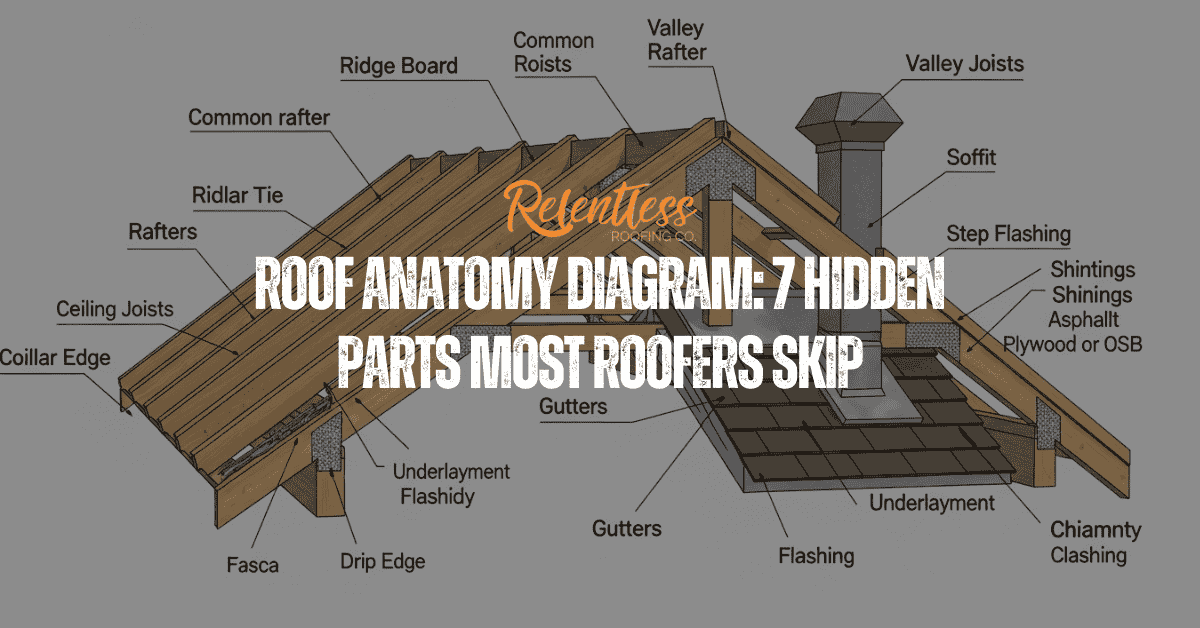
The most expensive roof failures start below the surface. A small problem in the deck, flashing, or underlayment can damage the whole roof before anything shows on the shingles. By the time a stain appears on your ceiling, the hidden layers may already be weak.
Many roof replacement jobs focus only on the visible roofing material while moisture and rot develop underneath. These are the 7 parts to ask about.
Hidden Part 1: The Roof Deck, the Layer That Fails First
The deck carries the full weight of the roofing, the snow load, and weather stress. Moisture trapped under shingles or poor attic ventilation causes rot, and soft spots develop over time. If weak decking is not replaced during a roof replacement, it can cause the new roof to fail early.
What you can check:
- Soft or sagging areas of the roof
- Uneven roof planes
- A musty smell in the attic
- Dark spots on the plywood or OSB, seen from the attic
Hidden Part 2: Underlayment
There are two main types of underlayment:
- Felt: the traditional asphalt-based option, sold as No. 15 or No. 30 (ASTM D226 Type I or Type II).
- Synthetic: stronger, lighter, and more resistant to tearing.
Cheap installs sometimes skip full coverage or overlap the sheets the wrong way. That leaves weak zones where water can get in, and once moisture reaches the deck, structural damage begins. Underlayment is especially important along valleys and roof edges, and it must be installed carefully and fully sealed during a replacement.
Hidden Part 3: Ice and Water Barrier
This membrane belongs in the high-risk areas of the roof:
- Along the eaves, from the edge to at least 24 inches inside the exterior wall line (Indiana Residential Code R905.1.2)
- In valleys where two roof planes meet
- Around chimneys and skylights
- Near other roof penetrations
Elkhart County is one of the Indiana counties where the eave ice barrier is required by code, not just recommended. Even so, some installers cut coverage to save money. When ice dams form, water can back up under the shingles and damage the deck. If this layer is missing or incomplete, your roof is exposed in its most vulnerable spots.
Hidden Part 4: Step Flashing at Walls and Chimneys
Step flashing protects the joint where the roof meets a vertical surface, like a sidewall or chimney. It is made of thin metal pieces layered with the shingles, each piece overlapping the next so water is directed away from the seam.
Step flashing fails when:
- The pieces do not overlap correctly
- Nails are placed in the wrong spots
- Sealant is used instead of proper metal flashing
When flashing fails, water travels behind the shingles. Water stains on an inside wall or ceiling near a chimney or sidewall often point to a flashing problem. Because flashing sits under the roof covering, many homeowners never realize it is the source of a leak.
Hidden Part 5: Valley Flashing
A valley carries concentrated runoff from two roof planes, so it handles more water than almost any other spot on the roof. Valley flashing protects that joint and keeps water off the deck. There are two main styles:
| Valley type | How it works |
|---|---|
| Open valley | A visible metal flashing channel directs water down the center |
| Closed valley | Shingles cover the valley, with the flashing hidden underneath |
Both work when installed correctly. The risk is debris: leaves collect in valleys and trap moisture. If valley flashing is poorly installed or rusted, the roof structure below it becomes vulnerable.
Hidden Part 6: The Ridge Vent System
Does a roof need to breathe? Yes. Without airflow, heat and moisture build up in the attic and weaken the roof deck. Over time, that can rot the plywood or OSB and shorten the life of asphalt shingles. Excess attic heat also wears out shingles faster and raises energy costs.
But exhaust alone is not enough. Ventilation has to be balanced:
- Soffit vents (intake) pull cool air in at the bottom.
- Ridge vent (exhaust) lets hot air out at the top.
Hidden Part 7: Soffit Intake Ventilation
Many homeowners focus only on the ridge vent, but intake matters just as much. Without air coming in at the eaves, hot air cannot escape properly through the ridge. Healthy soffit vents keep air moving, reduce trapped humidity in the attic, and help prevent deck damage and mold.
Blocked soffits are common. Paint, insulation, or debris can close the airflow paths. When that happens, moisture stays trapped, the deck weakens, and the roof fails early.
How Do the Parts of a Roof Work Together as One System?
Each part of your roof supports another, so when one fails, the problem spreads:
- The roof deck supports the underlayment and shingles.
- The underlayment keeps water off the deck.
- Flashing protects the joints where the roof meets walls and valleys.
- Ventilation keeps moisture from damaging the structure.
- Gutters move water away from the fascia and roof edges.
The chain also works in reverse. If ventilation fails, moisture damages the deck. If flashing fails, water reaches the underlayment. If the underlayment fails, the deck rots. That kind of hidden failure can lead to major interior damage and high roof leak repair costs.
Insulation is not part of the roof itself, but it works right alongside it. ENERGY STAR recommends R-60 of attic insulation for an uninsulated attic in Climate Zone 5, which includes Elkhart County. Together with ridge, soffit, and gable vents, insulation controls attic temperature and moisture, which is what keeps snow from melting unevenly and refreezing at the eaves.
Which Roof Parts Matter Most in a Michiana Winter?
Northern Indiana winters put specific parts of the roof under the most stress:
- Roof deck: it carries the design snow load of 30 psf on top of the roofing itself, so soft or rotted decking is a real risk.
- Ice and water barrier: it is the main defense when ice dams form at the eaves and meltwater backs up under the shingles, and it is required by code here.
- Valleys: they channel melted snow toward the gutters, so blocked or poorly flashed valleys leak first.
- Ridge and soffit vents: balanced airflow matters even more in freezing weather, when trapped warm, moist air can damage the deck.
- Gutters and downspouts: they need to be clear so meltwater can drain away from your walls and foundation.
For a full winter checklist, read our guide to roofing maintenance for snowy climates in Indiana.
What Should You Inspect Before You Hire a Roofer?
You do not need to climb on the roof to learn a lot. Before moving forward with a full roof replacement, check these items from the ground and the attic:
- Shingles that are curling, cracked, or missing
- The deck warning signs listed above: dark stains on the plywood or OSB, or sagging areas
- Debris built up in the valleys
- The condition of the flashing around chimneys and sidewalls
- Soffit vents that are blocked
- A ridge vent that runs continuously along the ridge
- How many layers of shingles are on the roof: the code allows at most two, so a roof that already has two layers must be torn off before a new one goes on (IRC R908.3)
Ask your roofer about underlayment coverage, ice barrier extent, and flashing details. A qualified contractor should be able to explain how your roof structure, ventilation, and flashing protect your home. For a longer list, see our roofing inspection checklist.
Signs You May Need a Roof Replacement
Some problems point past a simple repair:
- Missing or damaged shingles: cracked or missing shingles expose your home to weather damage.
- A sagging roof: sagging signals a structural problem that needs attention right away.
- Leaks or water stains: stains on ceilings or walls mean water is already getting in. If you have an active leak, see what to do when your roof leaks in the rain.
- An aging roof: InterNACHI puts a 3-tab asphalt roof at about 20 years and an architectural roof at about 30, so a roof past 20 years may need replacement to keep protecting your home.
- Daylight through the roof boards: light in the attic means there are gaps or holes.
Not sure which way to go? Our guide on roof repair vs. roof replacement in Elkhart walks through the decision. If you are planning a new roof, see our Elkhart roof replacement cost guide or Indiana roof replacement costs.
How Relentless Roofing Co. Can Help
A surface-level look at the shingles is not enough. The right inspection checks the full roof anatomy: the deck, underlayment, ice barrier, flashing, valleys, and ventilation, not just the covering you can see.
Relentless Roofing Co. offers complete roof system inspections for homeowners in Elkhart, Goshen, South Bend, Mishawaka, Granger, and across Michiana. If we find a problem, we handle roof leak repair, storm damage roof repairs, and full roof replacement.
To keep every part of your roof in good shape between inspections, read how to extend the life of your roof with regular maintenance.
Frequently Asked Questions About Roof Anatomy
What are the parts of a roof called?
The main parts of a roof are the framing (rafters or trusses), the roof deck, underlayment, ice and water barrier, flashing, shingles or other covering, the ridge, vents, drip edge, fascia, soffit, gutters, and downspouts. This guide covers 27 parts in total, grouped by where they sit on the roof.
What is the anatomy of a roof frame?
A roof frame is made of rafters or trusses that carry the roof’s weight, ceiling joists that tie the walls together, collar beams that keep opposite rafters from sagging, and a ridge beam at the peak. The sheathing is then attached over the frame to form the roof deck. In Elkhart County the frame is designed for a 30 psf ground snow load and 115 mph winds.
What is roof decking and why is it important?
Roof decking is the structural base of the roof, usually plywood or OSB. It supports the underlayment and roof covering and passes their weight to the rafters or trusses. If the deck is weak or rotted, the entire roof can fail.
Does a roof need ventilation to last longer?
Yes. Proper ventilation prevents moisture buildup, protects the deck, and extends the life of the shingles and the whole roof system. The code baseline is 1 square foot of vent area per 150 square feet of attic floor, balanced between soffit intake and ridge exhaust.
Is an ice and water barrier required in Indiana?
In Elkhart County, yes. Indiana Residential Code R905.1.2 requires an ice barrier at the eaves in the counties listed in Table R301.2(1), and it must extend at least 24 inches inside the exterior wall line. Many southern Indiana counties are not on the list, but manufacturer instructions may still require it.
What are the most vulnerable parts of a roof?
Valleys, flashing around chimneys and sidewalls, roof edges, and any spot where two roof planes meet are the most leak-prone areas of a roof.
Know Your Roof, Protect Your Home
Roof anatomy is more than shingles. The deck, underlayment, ice barrier, flashing, valleys, and ventilation all work together, and most major leaks start in the parts you cannot see from the ground. When you know what each part does, and which code rules apply to your county, you can ask better questions and catch problems before they become costly repairs.
Want a professional look at every layer of your roof? Schedule a free roof inspection with Relentless Roofing Co. Call 574-218-0642 or contact us online.