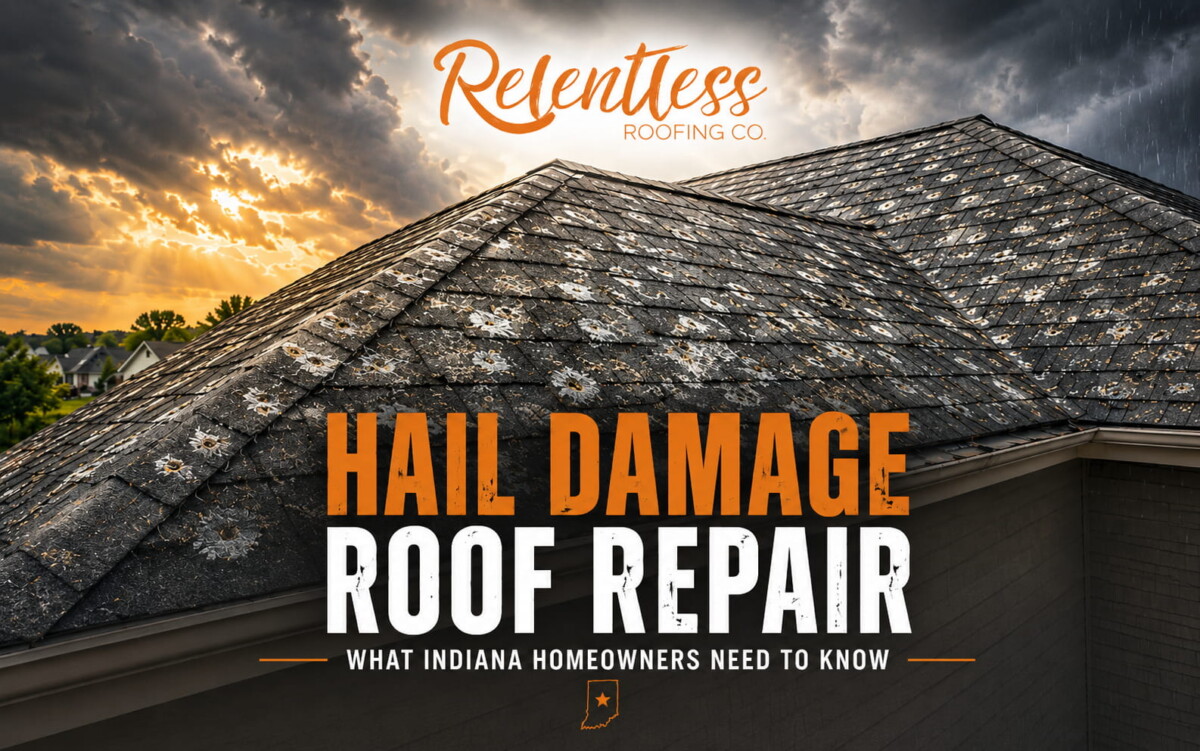
Hail damage roof repair helps Indiana homeowners fix storm damage before it turns into leaks, water damage, and higher repair costs. The biggest risk is hidden damage. A roof may look fine from the ground, while asphalt shingles, granules, flashing, vents, gutters, and underlayment have already taken a hard hit.
Introduction
Indiana hailstorms can damage a roof in minutes, but the signs may not show right away. A hail strike can loosen shingle granules, bruise the fiberglass mat, dent vents, bend flashing, and weaken water-shedding areas around valleys, ridge caps, and penetrations.
This is why Indiana homeowners should think in stages. The Indiana Hail Damage Lifecycle includes Impact, Hidden Degradation, Claim Window, and Long-Term Resilience. First, hail hits the roof. Then weak spots grow. Then the homeowner must decide whether to inspect, file a claim, repair, replace, or upgrade. That process protects the home better than guessing from the driveway.
Key Takeaway
- A hail-damaged roof is not always a leaking roof.
- Check visible signs from the ground before making any repair or claim decision.
- Document possible hail damage with photos, notes, and the storm date.
- Schedule a professional roof inspection to confirm hidden damage.
- Review repair, replacement, insurance claim, policy terms, and contractor options together before choosing the next step.
What Is Hail Damage Roof Repair, and Why Should Indiana Homeowners Care?
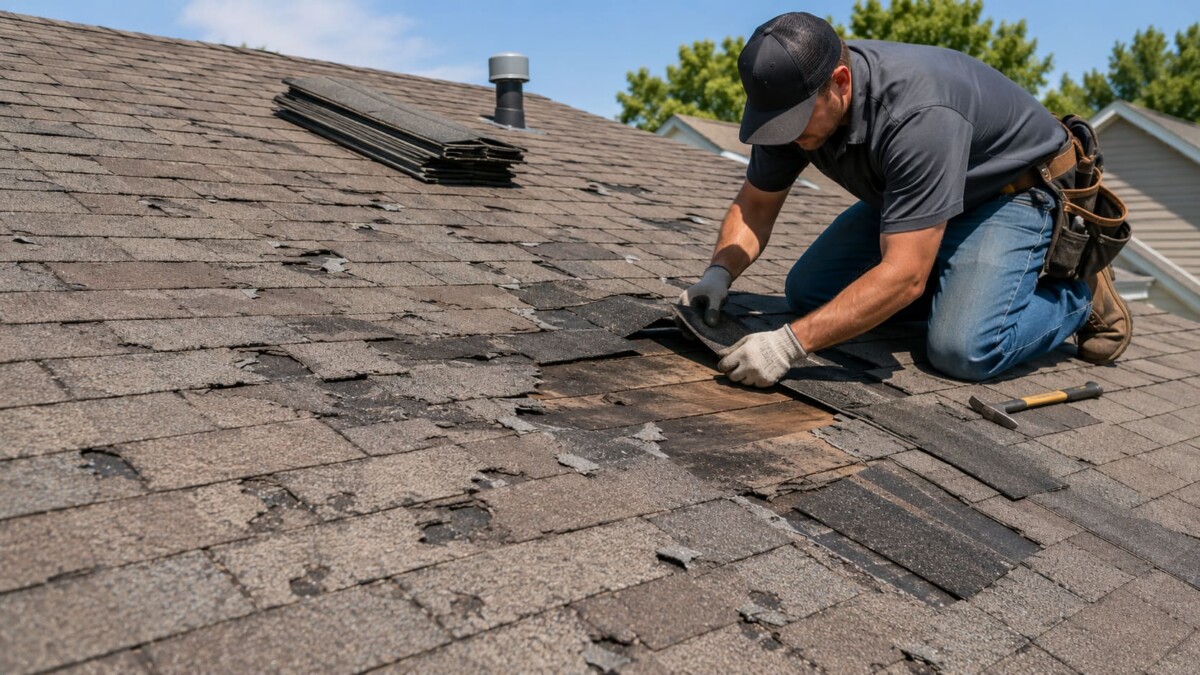
Hail damage roof repair means fixing damage caused by hailstones, wind-driven impact, and storm debris. It may include replacing damaged shingles, repairing flashing, replacing dented vents, sealing exposed areas, or installing a new roof when the damage is widespread.
Indiana homeowners should care because hail damage on your roof may stay hidden for months. Missing granules and bruised shingles can reduce roof life before a leak appears. The roof may still shed water today, yet the damaged areas may age faster under sun, rain, and freeze-thaw cycles.
This is the Hidden Degradation stage of the Indiana Hail Damage Lifecycle. Once granules are knocked loose, the asphalt layer becomes more exposed. That can lead to cracks, moisture entry, and roof repair needs later. A short inspection after a hail storm can protect your home and give you better proof if an insurance claim becomes necessary.
How Hail Damages an Asphalt Shingle Roof Beneath the Surface
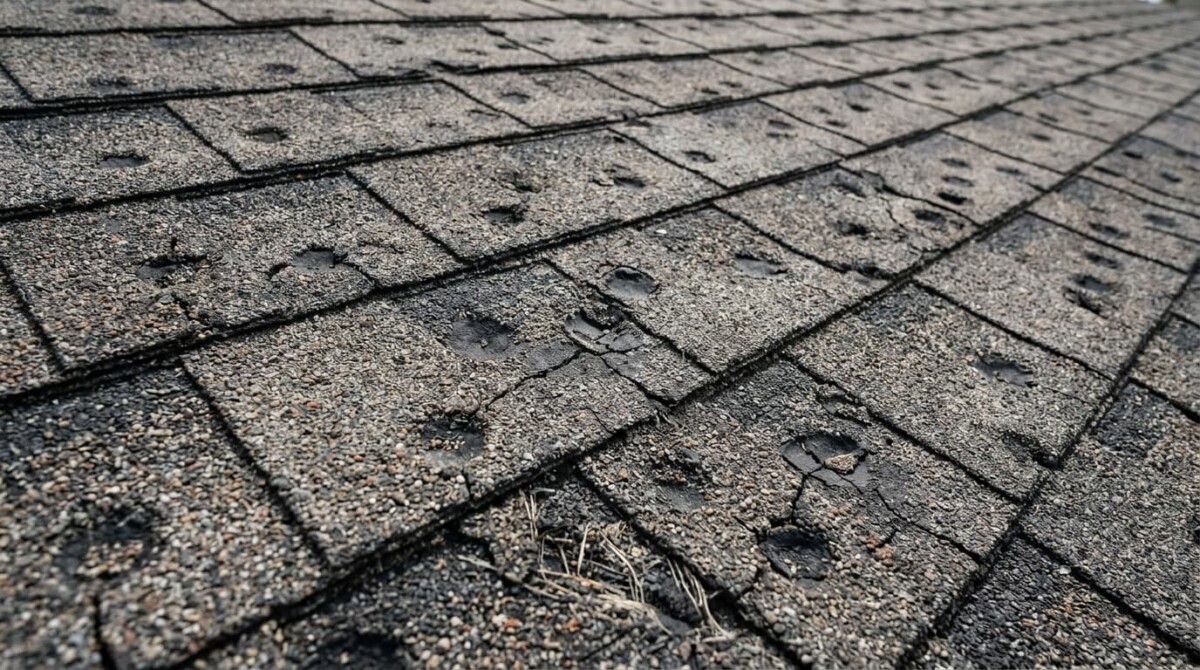
Hail damages an asphalt shingle roof by striking the surface hard enough to loosen granules, bruise the shingle, crack the asphalt layer, or fracture the fiberglass mat beneath it. Functional hail damage is about lost roof performance, not just visible marks.
Granule Loss Weakens the Shingle Surface
Granules protect asphalt shingles from UV rays, rain, heat, and daily wear. When hail impact knocks them loose, the darker asphalt layer becomes exposed. That exposed spot can dry out, crack, and absorb more moisture over time.
Bruising Can Damage the Fiberglass Mat
Bruising happens when hail crushes the shingle beneath the surface. A professional roof expert may feel a soft spot during inspection. This type of damage is easy to miss from the ground, but it can weaken the shingle’s ability to shed water.
Cracks, Flashing Damage, and Metal Dents Show Storm Impact
Larger hailstones can crack older shingles, dent gutters, bend vents, and loosen flashing. These marks help show how hard the storm hit. A dented gutter may be cosmetic, but a cracked shingle or damaged flashing can lead to leaks.
Signs of Hail Damage on Your Roof You Can Check Safely From the Ground
You can look for possible signs of hail damage from the ground, but you cannot confirm the full condition of the roof without a professional roof inspection. Ground checks help you decide whether to call a roofer. They should not replace a full inspection after significant damage.
| Safe Ground Check | What It May Tell You |
| Dents on gutters and downspouts | Hail likely hit the home with force |
| Cracked siding and windows | The storm may have struck at an angle |
| Torn window screens | Wind-driven hail may have hit hard |
| Dented AC condenser fins | Soft metal damage may point to roof impact |
| Granules near downspouts | Shingles may have lost protective coating |
| Dark marks on visible shingles | Granule loss or bruising may be present |
Stay off the roof after a hailstorm. Wet shingles, steep slopes, and loose granules can make the roof unsafe. Use your phone camera, binoculars, and notes instead.
A professional roof expert can check hidden hail bruises, ridge caps, vents, flashing, valleys, and attic moisture. These checks matter because hidden bruises sit in the Hidden Degradation stage. They may not leak right away, but they can worsen through Indiana heat, rain, and winter freezing.
Should You Inspect Hail Damage on Your Roof Yourself or Call a Professional Roof Expert?
You should do a safe ground check first, then call a professional roof expert if you suspect hail damage, see dents, find granules, or know your area had hailstones about one inch in diameter or larger. A trained inspector can confirm damage and document it for insurance.
Follow this simple post-storm process:
- Walk around the home after the storm has passed.
- Take photos of siding, gutters, windows, vents, and AC units.
- Check the attic for water stains, damp insulation, or a musty smell.
- Look for loose granules near downspouts.
- Save the storm date and any National Weather Service or local weather alerts.
- Call a local roofing contractor for a full inspection if you see possible damage.
A strong inspection should include shingles, valleys, roof deck concerns, underlayment where visible, flashing, pipe boots, ridge caps, gutters, downspouts, skylights, chimney areas, and attic moisture signs.
The inspector should also provide photos and written notes. This turns the inspection into a case file. It helps show where the roof sits in the lifecycle and gives your insurance adjuster clearer evidence if you file a claim.
When Should You File a Hail Damage Roof Insurance Claim in Indiana?
You should file a hail damage roof insurance claim when a professional inspection finds functional damage that may cost more than your deductible. If damage is minor, inspect first. A weak claim can waste time and may not lead to payment.
| Situation | Better First Move | Why It Matters |
| A few gutter dents only | Inspect first | Roof damage may be minor |
| Granules in gutters | Inspect first | Could be hail or normal wear |
| Widespread shingle bruising | Prepare claim | Functional damage may exist |
| Active leak after hailstorm | Contact your insurance and roofer | Water damage can spread fast |
| Older roof with past wear | Review policy first | ACV may reduce payment |
Homeowners insurance terms can change the outcome. Actual Cash Value, or ACV, pays after depreciation. Replacement Cost Value, or RCV, may pay more after the approved work is done. Some policies also have separate wind and hail deductibles, roof age limits, or cosmetic-damage exclusions.
This is the Claim Window stage. Acting early helps connect the damage to a known storm. Waiting too long can make it harder to prove that damage from hail caused the problem.
What Affects Hail Damage Roof Repair Costs in Indiana?
Hail damage roof repair costs depend on roof size, roof pitch, access, shingle type, damage spread, labor, material choice, and insurance coverage. A small repair may cost far less than a full replacement, but patching a compromised roof can cost more later.
| Cost Driver | Why It Changes the Price |
| Roof size | Larger roofs need more shingles, labor, and cleanup |
| Roof pitch | Steep roofs need more safety setup |
| Damage spread | One slope costs less than damage across several slopes |
| Roof age | Older shingles may be harder to match or repair |
| Roof materials | Asphalt shingles, metal roof panels, and specialty materials cost differently |
| Flashing and vents | Damaged accessories add labor and parts |
| Insurance terms | Deductible, ACV, RCV, and exclusions affect out-of-pocket cost |
Minor shingle repair may work for isolated damage. Flashing or vent repair may solve a small water-entry risk. Partial repair may fit one damaged slope. Full roof replacement may be needed when extensive damage affects many areas.
Decision checkpoint: do not judge the cost by online averages alone. Get a written scope of work. Make sure it separates shingles, flashing, gutters, ridge caps, vents, disposal, warranty, and any insurance supplement needs.
Should You Repair or Replace a Hail-Damaged Roof?
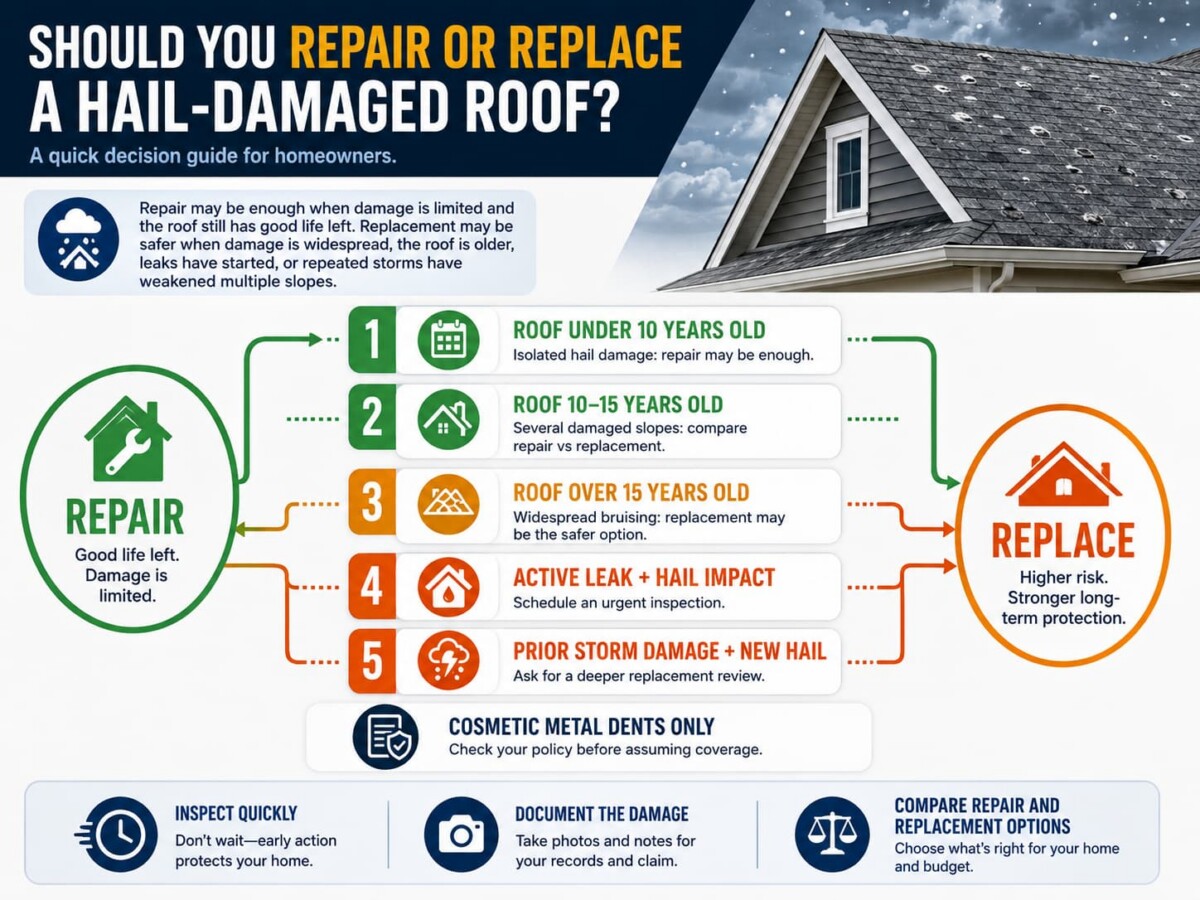
You should repair a hail-damaged roof when damage is isolated, the roof is newer, and the shingles still have useful life. Replacement may be safer when damage is widespread, the roof is older, leaks have started, or repeated storms have weakened several slopes.
Use this decision map:
- Roof under 10 years old + isolated damage: roof repair may be enough.
- Roof 10–15 years old + several damaged slopes: compare repair or replacement.
- Roof over 15 years old + widespread bruising: full roof replacement may be the safer option.
- Active leak + hail impact: schedule urgent inspection.
- Prior storm damage + new hail damage: ask for a deeper replacement review.
- Cosmetic metal dents only: review your policy before assuming coverage.
Here is a simple example. A 12-year-old asphalt shingle roof near Indianapolis gets quarter-size hail. The homeowner sees granules near the downspout but no leak. That roof should be inspected before any claim decision. If damage is isolated, repair may work. If bruising covers several slopes, replacement may protect the home better.
Repair fixes a problem area. Replacement resets the roofing system. The right answer depends on roof age, extent of the damage, insurance coverage, and inspection findings.
How Can Better Roof Materials Protect Your Home From Future Hailstorms?
Better roof materials can reduce future hail damage, but no roof is hail proof. Class 4 impact-resistant shingles, stronger architectural shingles, SBS-modified asphalt, and some metal roofing systems may perform better in Indiana hailstorms.
Class 4 impact-resistant shingles are tested under UL 2218. In plain language, that test checks how well roofing material handles impact without cracking. Class 4 is the highest rating in that system. It does not mean hail can never damage the roof. It means the shingle has stronger impact resistance under test conditions.
A metal roof can shed water well and may last a long time, but large hail can still cause dents. Some homeowners accept that look. Others do not. Some insurance policies may treat metal dents as minor cosmetic damage, so ask your insurance company how those claims are handled.
An upgrade can make sense during a covered roof replacement, in a county with repeated hailstorms, or on a home where the owner plans to stay long term. Ask about Class 4 shingles, manufacturer warranty, possible insurance discounts, and the real cost difference before choosing.
How to Avoid Hail Damage Roof Repair Scams After a Storm
You can avoid hail damage roof repair scams by slowing down, checking the contractor’s local presence, asking for proof of insurance, reading every form, and avoiding “free roof” promises. A reputable Indiana roofing contractor will explain the damage, scope of work, warranty, and insurance steps in writing.
Red flags after a hailstorm include:
- Out-of-state plates and no local office
- Pressure to sign the same day
- No written inspection report
- No proof of liability insurance
- Large upfront cash demands
- Sparse reviews or unclear business history
- Promises to “eat the deductible”
- Pushy door-to-door sales after a major storm
- Assignment of Benefits, or AOB, forms you do not understand
Saying no to the wrong contractor is as important as hiring the right one. Bad repairs can leave you with leaks, denied claim items, weak warranty support, or missing paperwork.
A reliable local roofing contractor should provide photos, a written estimate, proof of insurance, product options, warranty details, and clear communication with the adjuster. The best choice is often a contractor who understands both roofing and hail-damaged roof insurance claim work.
Conclusion
Hail damage roof repair in Indiana is best handled as a clear process, not a guess. Start with safe ground checks. Document what you see. Schedule a professional roof inspection. Review insurance terms. Then compare repair, replacement, or better roof materials based on real findings.
The Indiana Hail Damage Lifecycle helps you move from storm impact to long-term protection. If your home was hit by a recent hailstorm, get a local inspection before hidden damage turns into leaks, water damage, and higher repair costs.
You May Also Want to Read
You may also want to read:
- File Wind or Hail Claim on an Old Roof
https://relentlessroofingco.com/file-wind-or-hail-claim-on-a-old-roof/ - Why Do Roofers Want to See Your Insurance Estimate?
https://relentlessroofingco.com/roofers-want-to-see-insurance-estimate/
FAQs
Is it worth getting hail damage roof repair?
Yes, hail damage roof repair is worth it when the damage affects shingles, flashing, vents, gutters, or water protection. Small repairs can prevent leaks. Larger repairs can protect home value. Start with an inspection so you know whether the damage is minor, functional, or part of a larger replacement need.
Can hail damage on a roof be repaired without replacing the whole roof?
Yes, hail damage on a roof can be repaired without full replacement when the damage is limited to a small area. This may include replacing shingles, vents, flashing, or ridge caps. If damage is spread across many slopes, full replacement may be safer.
Will homeowners insurance pay for roof hail damage in Indiana?
Homeowners insurance may pay for roof hail damage when the policy covers wind and hail and the damage is tied to a covered storm. Payment depends on your deductible, ACV or RCV terms, roof age, exclusions, and adjuster findings. Get inspection photos before filing.
How much hail damage is needed to replace a roof?
A roof may need replacement when hail damage is widespread, functional, and found across several roof slopes. Insurers often review damage patterns, shingle condition, hail size, and repair feasibility. A professional inspection can show whether repair or replacement makes more sense.
Are impact-resistant shingles worth it for Indiana homes?
Impact-resistant shingles can be worth it for Indiana homes in areas with repeated hailstorms. They may reduce future damage and may qualify for insurance discounts. They cost more upfront, so compare roof age, local hail risk, warranty terms, and carrier discounts before choosing them.