
When do Michiana homeowners actually call a roofer? What do they ask for — a patch, or a whole new roof? And how much of local roofing demand is really driven by storms?
We stopped guessing and looked at the data. Our team analyzed multi-year records of homeowner roofing requests submitted across Elkhart County and 10+ Michiana communities — Elkhart, Goshen, South Bend, Mishawaka, Granger, Bristol, Middlebury, Nappanee, Wakarusa, Osceola, and nearby southwest Michigan towns. The results are now published as the Michiana Roof Report 2026, our first annual study of local roofing demand.
Here are the findings that surprised even us.
1. The spring rush is real — and it’s compressed into two months
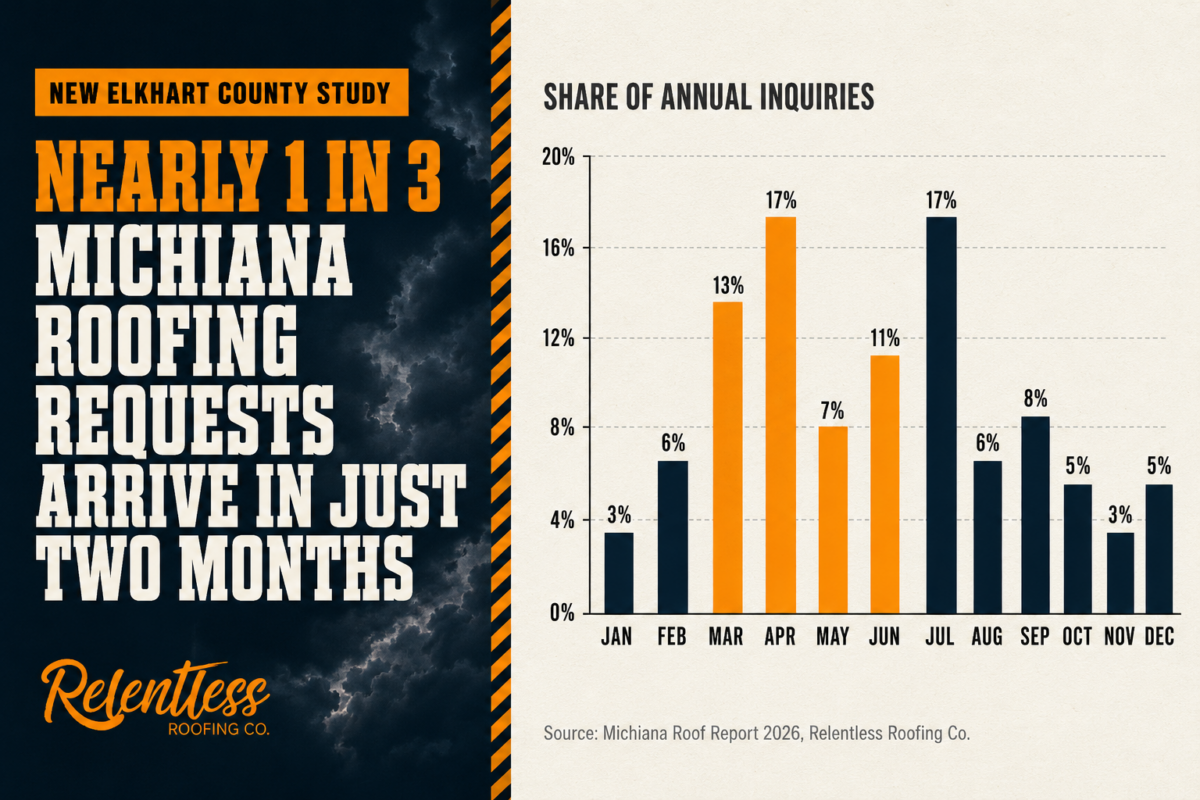
Nearly one in three roofing requests (30%) arrives in March and April alone. Stretch the window from March through July and it captures almost two-thirds (64%) of the entire year’s demand. April is Elkhart County’s single busiest roofing month, at more than double the volume of an average month.
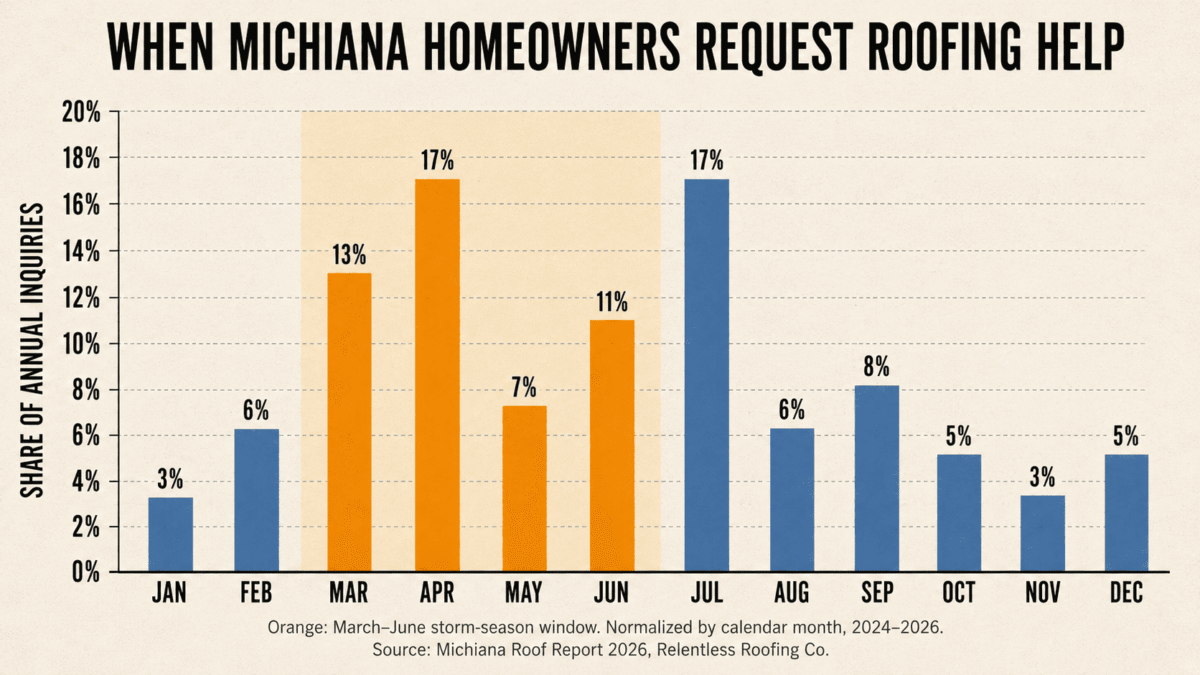
Why the pile-up? Two forces collide every spring in northern Indiana. Winter freeze-thaw damage becomes visible as the snow melts in March, and the region’s severe-weather season — hail, straight-line winds, occasional tornado activity — opens in April. A second peak follows in July, driven by summer storms and post-holiday home projects.
What it means if you own a home here: contractor schedules fill fastest exactly when everyone needs help at once. Homeowners who book an inspection in February — before the rush — get faster scheduling and more breathing room for insurance paperwork.
2. Homeowners are skipping repair and going straight to replacement
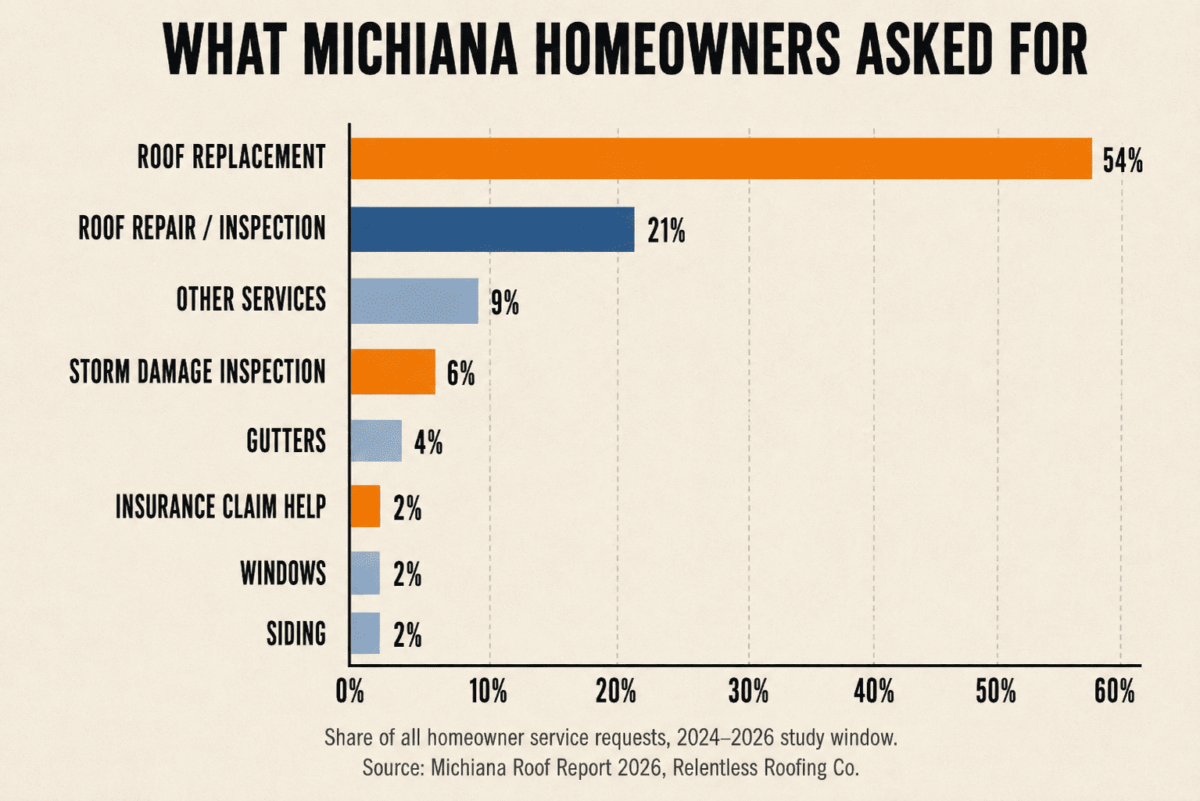
The most common assumption in roofing is that homeowners always try to patch first. Our data says otherwise: 54% of all inquiries were for full roof replacement, against 21% for repair — a 2.6-to-1 ratio.
The likely driver is age. Twelve percent of detailed homeowner messages referenced how old their roof was — “original roof,” “20-plus years old.” Much of Michiana’s housing stock went up during the construction booms of the 1990s and 2000s in Elkhart, Goshen, and Granger, which means a large share of local roofs are hitting end-of-life at the same time.
3. Storms and insurance drive 15% of all roofing demand
Fifteen percent of all requests traced directly to a weather event or insurance process — storm-damage inspections, insurance claim help, or messages describing tornado damage, fallen trees, hail, or wind losses.
The pattern sharpened after the spring 2026 storms in Elkhart County: March–April 2026 was the busiest two-month stretch in the entire study window, with a visible spike in storm- and tree-related messages. The takeaway for homeowners is simple: after a regional storm, demand surges everywhere at once. Those who document damage and request inspections within the first week get scheduled weeks ahead of those who wait — a meaningful difference when insurance deadlines are running.
4. A third of homeowners reach out when contractors are closed
Roofing problems don’t keep business hours. 34% of requests were submitted before 8 a.m. or after 5 p.m., 16% arrived on weekends, and 58% came from a mobile device. Monday and Tuesday were the two busiest days — together 40% of all inquiries — the classic “weekend damage, Monday call” pattern.
5. Leaks lead the list — and metal roofing is rising
Among requests that described the problem, leaks and storm damage tied as the most common issues. Just behind them: metal roofing, referenced in 12% of messages — a notable share in a market long dominated by asphalt shingles — and winter damage (ice, snow, ice dams), confirming Michiana roofs take a beating year-round, not just in storm season.
Explore the full report
The complete study includes interactive charts, hour-by-hour submission patterns, the full topic breakdown from homeowner messages, and our methodology.
Read the full Michiana Roof Report 2026 →
Journalists and researchers: every statistic in the report may be reproduced with attribution. Contact us for methodology details or record-level data.