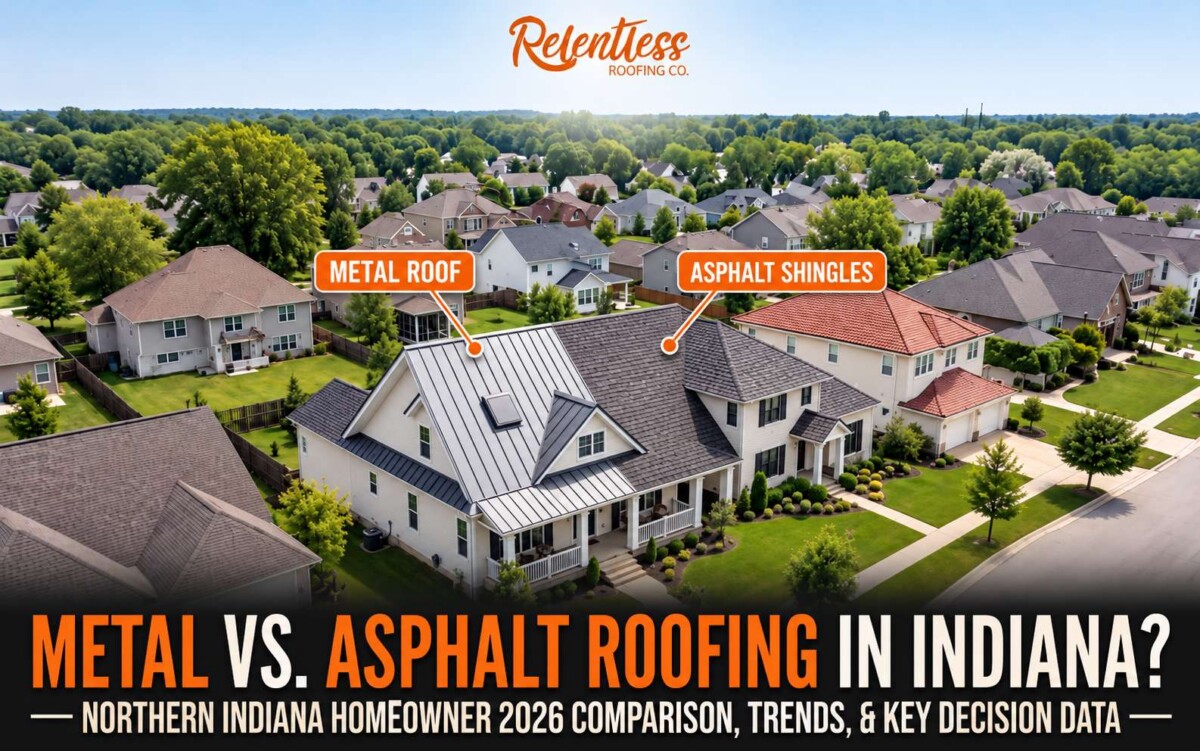
Metal vs asphalt roofing depends on your budget, how long you plan to own the home, and how your roof handles Northern Indiana weather. Asphalt shingles usually cost less and are easier to repair. Metal roofing can last longer and shed snow well. Attic conditions, roof design, underlayment, and installation quality also affect the result.
Introduction
Northern Indiana homeowners have more to consider than material price. Snow, ice, hail, wind, roof slope, attic conditions, and ownership plans can all affect which roofing system makes sense.
According to the Michiana Roof Report 2026, metal roofing appeared in 12% of detailed homeowner messages. The same study found winter or ice damage in 12% of relevant homeowner messages.
Those findings make this comparison especially useful locally. A good decision should consider both the roofing material and the full roof system beneath it.
Key Takeaway
- Asphalt shingles usually offer a lower upfront cost and simpler repairs.
- Metal roofing usually costs more but can provide a much longer service life.
- Metal can shed snow faster, while asphalt tends to hold snow longer.
- Ice dam problems can affect either material if the attic has heat loss, poor insulation, or ventilation problems.
- Architectural and impact-resistant shingles can perform much better than basic shingles.
- Standing seam metal usually has different maintenance needs than exposed-fastener metal.
- Your budget, roof design, weather exposure, and ownership timeline should guide the final choice.
Metal Roof vs Asphalt Shingles: What Are the Main Differences?
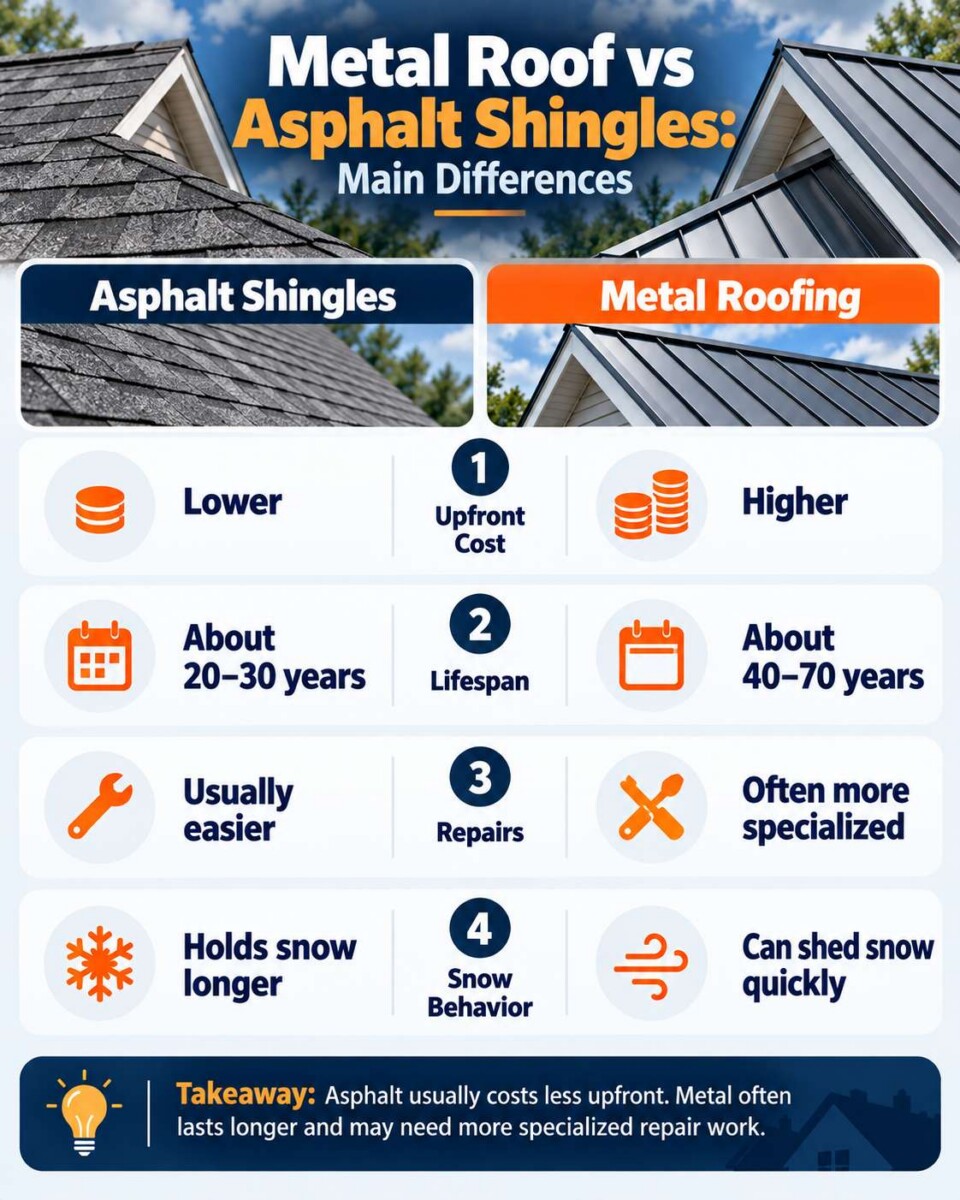
The biggest differences are upfront cost, expected lifespan, maintenance, repair access, and snow behavior. Asphalt shingles are familiar, widely available, and usually cheaper to install. Metal systems generally cost more and may last much longer. Product grade matters, so homeowners should compare specific roofing systems rather than broad material names.
| Factor | Asphalt Shingles | Metal Roofing |
| Upfront cost | Lower | Higher |
| Typical lifespan | About 20–30 years | About 40–70 years |
| Repairs | Usually easier | Often more specialized |
| Snow behavior | Holds snow longer | Can shed snow quickly |
| Maintenance | Moderate | Depends on system |
| Styles | Very broad | Broad |
| Local labor | Widely available | More system-specific |
Architectural and Class 4 impact-resistant shingles perform differently from basic three-tab shingles. Metal also varies. Standing seam uses concealed fasteners, while exposed-fastener panels use visible screws and washers that may need more attention over time.
Why Are Northern Indiana Homeowners Comparing Metal and Asphalt Roofing?
Northern Indiana brings snow, freezing temperatures, spring thaws, wind, hail, and changing temperatures. These conditions can expose weak flashing, old shingles, loose fasteners, poor underlayment, and attic problems.
According to the Michiana Roof Report 2026, metal roofing was referenced in 12% of detailed homeowner messages. This figure shows observed homeowner interest during the study period. It does not prove year-over-year growth.
The study also found winter or ice damage in 12% of relevant homeowner messages. That matters because winter leaks are often blamed on the roof covering alone.
An ice dam forms when heat warms part of a snow-covered roof. Meltwater moves down to colder eaves and freezes again. Roofing material affects snow movement, while attic air leaks, insulation, ventilation, roof shape, and drainage often control why the problem starts.
How Much Do Metal and Asphalt Roofs Cost, and How Long Do They Last?
Asphalt usually wins on initial price. Metal becomes more attractive when the homeowner expects to keep the property for decades.A useful roof replacement cost guide should include expected service life, future replacement needs, repair costs, and the exact system being quoted.
| Situation | Asphalt | Metal |
| Lower starting budget | Strong fit | Harder to justify |
| Staying 5–10 years | Often practical | Payback may be limited |
| Staying 20–30+ years | May require another replacement | Longer lifespan becomes more valuable |
| Simple future repairs | Easier in many cases | May need a metal specialist |
Architectural asphalt shingles commonly fall in the 20 to 30-year lifespan range. Many metal systems are commonly placed around 40 to 70 years. Actual life depends on product quality, installation, maintenance, weather exposure, ventilation, and roof design.
A homeowner planning to sell in eight years may value lower upfront cost. Someone expecting to stay for 30 years may care more about avoiding another full roof replacement.
Which Roof Performs Better in Northern Indiana Snow, Ice, Wind, and Hail?
Both materials can perform well in Northern Indiana when the right product is installed correctly. Metal usually has an advantage in snow shedding, while high-quality asphalt can still provide strong wind and hail performance. Winter leaks and ice dams require a wider roof-system review because roofing material alone does not control every failure.
Snow and Ice
Smooth metal panels allow snow to slide more easily. That can reduce long-term snow buildup, though falling snow may become a concern above doors, sidewalks, decks, or driveways. Snow guards can slow or control that movement.
Asphalt has more surface texture, so snow tends to remain in place longer.
Ice Dams
A metal roof cannot correct a warm, leaky attic. Air sealing, insulation, ventilation, underlayment, drainage, and roof geometry all affect ice dam risk.
Homeowners with recurring winter leaks should have these areas checked before assuming a material change will solve the problem.
Wind and Hail
Impact-resistant architectural shingles can provide much stronger storm protection than basic shingles. Metal can also handle severe weather well, though hail may leave cosmetic dents on some panels.
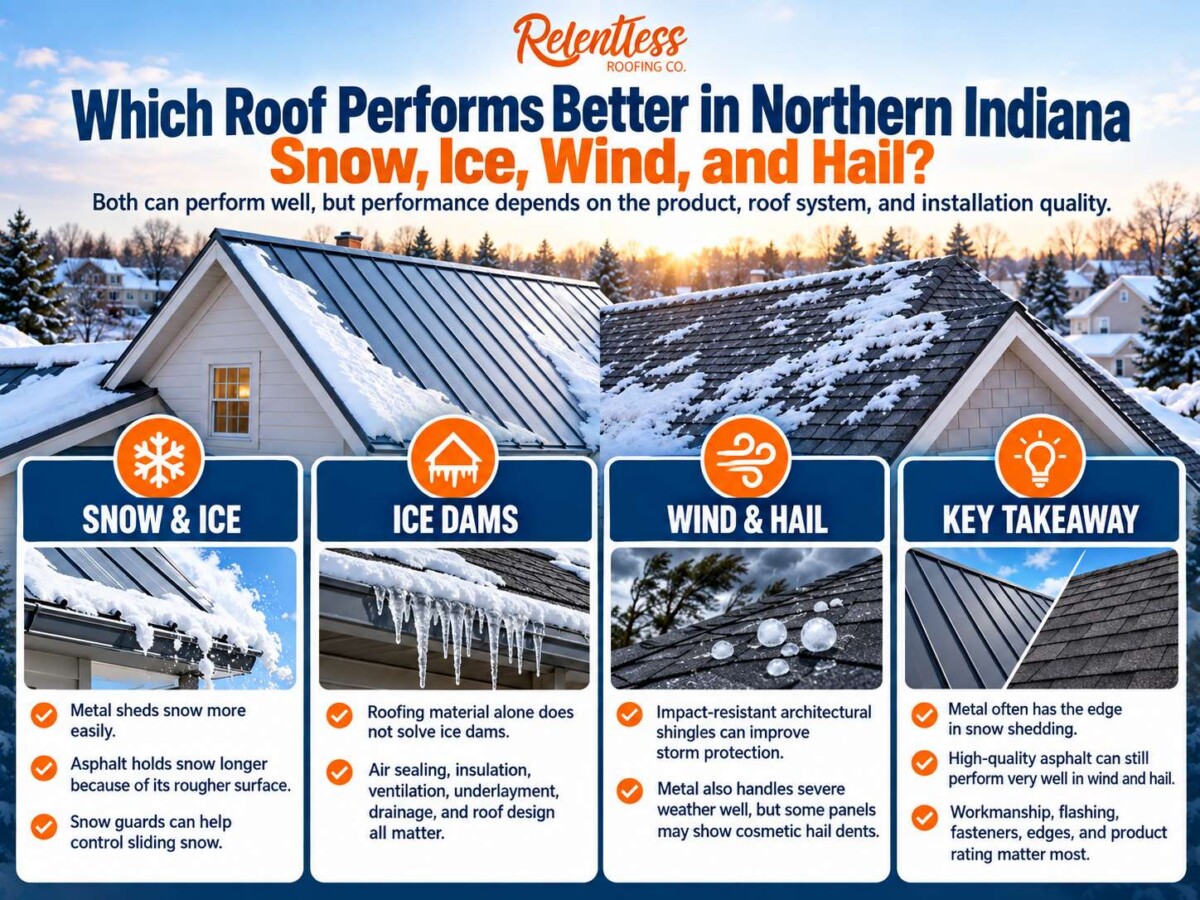
The product rating, roof edges, flashing, fastening system, and workmanship all affect storm performance.
Which Roof Is Easier to Install, Maintain, and Repair?
Asphalt is usually simpler to install and repair because more residential roofing crews work with shingles. Metal may need fewer repairs over its service life, though the work can require a contractor familiar with the exact panel system.
Asphalt ownership usually involves:
- Checking for missing or damaged shingles after storms
- Watching for granule loss as the roof ages
- Replacing small damaged areas when practical
- Finding matching shingles if an older product line has changed
Metal ownership usually involves:
- Checking seams, flashing, and sealants
- Inspecting exposed fasteners on systems that use them
- Watching coating condition
- Finding matching panels when repairs are needed
Homeowners should also separate the material warranty from the workmanship warranty. One covers qualifying product defects. The other covers qualifying installation issues.
Insurance rules also vary by company and policy. Ask your insurer about the exact roofing product before counting on any premium reduction.
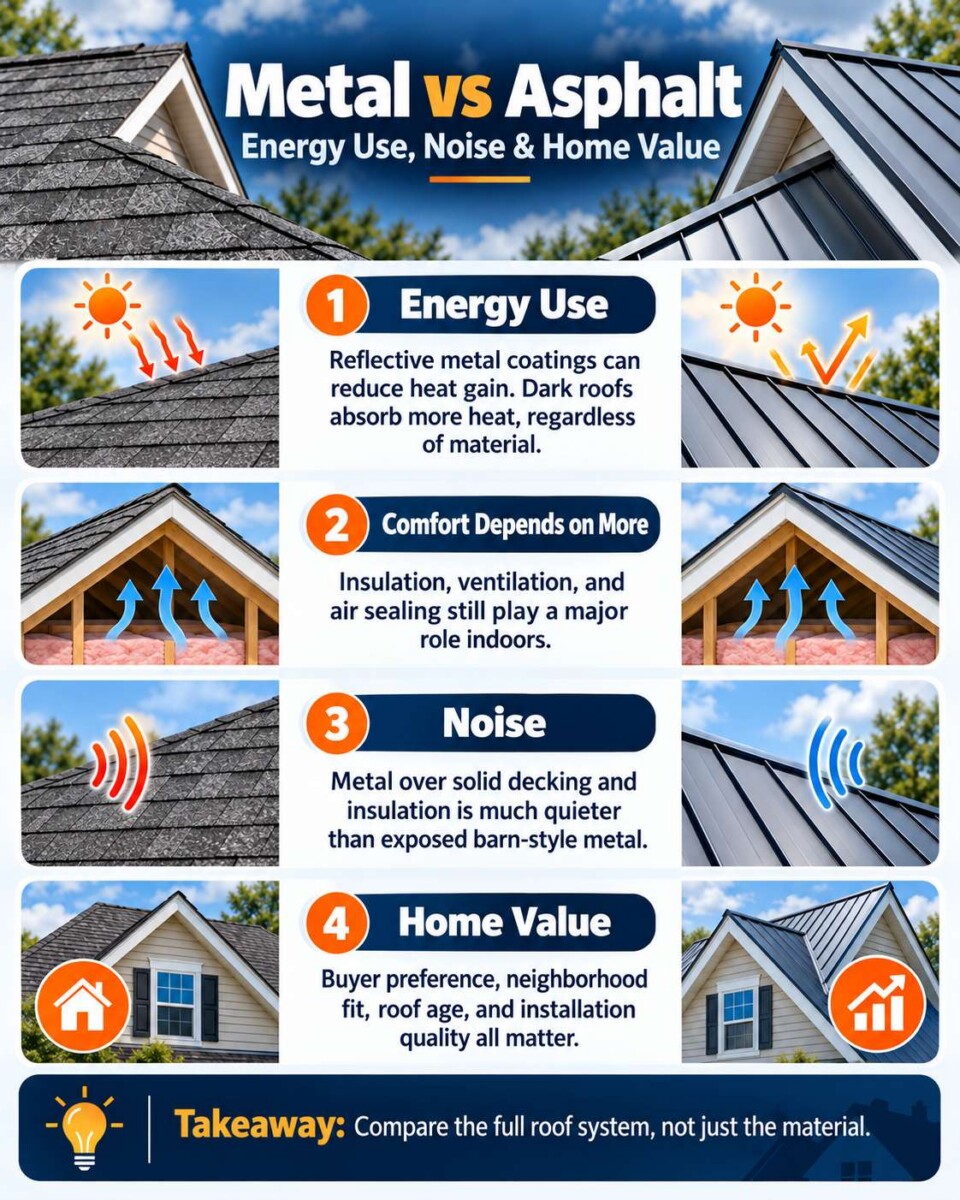
How Do Metal and Asphalt Roofs Compare for Energy Use, Noise, and Home Value?
Metal roofing can reflect more solar heat when it uses a suitable coating or lighter finish. Dark roofing surfaces can absorb more heat regardless of material. Attic insulation, ventilation, and air sealing still play a major role in how comfortable the home feels.
Noise depends heavily on the layers below the roof. Metal installed over solid decking, underlayment, insulation, and an attic performs very differently from exposed metal on a barn. Homeowners should judge the complete residential assembly rather than the panel alone.
Home value is less predictable. A long-lasting metal roof may appeal to some buyers, while architectural shingles may fit traditional neighborhoods or HOA rules more easily. Roof age, condition, installation quality, and remaining useful life often matter as much as material.
Which Is Better for Your Home: Metal or Asphalt Roofing?
Asphalt often makes sense for homeowners who want a lower starting cost, easy repair access, and a traditional appearance. Metal becomes more attractive for long-term owners who can handle the higher initial price and want a longer expected service life. Your roof shape and attic condition can change either decision.
| Your Priority | Option to Compare First |
| Lower upfront cost | Architectural asphalt |
| Staying 25+ years | Standing seam metal |
| Easy future repairs | Asphalt |
| Frequent hail concerns | Class 4 asphalt or suitable metal |
| Snow shedding | Metal |
| HOA or traditional appearance | Architectural asphalt |
| Recurring ice dams | Inspect attic and roof assembly before choosing either |
A homeowner with winter leaks should avoid choosing a new material until the attic, deck, underlayment, ventilation, flashing, and drainage are checked. Fixing the source of the problem may matter more than changing from shingles to metal.
What Should You Ask Before Choosing a New Roof?
Before choosing metal or asphalt roofing, ask these questions so you can compare the right system for your home, budget, and long-term plans.
- How long do I expect to own this home?
A longer stay can make metal’s longer service life more valuable. - Which roofing product am I being quoted?
Confirm whether it is architectural shingles, impact-resistant shingles, standing seam metal, exposed-fastener panels, or another system. - Are my roof deck and attic in good condition?
Moisture, poor ventilation, or insulation problems should be addressed during replacement. - Has my home had ice dams or winter leaks?
Past winter problems may affect your repair vs. replacement decision because they can point to attic or roof-system issues. - What maintenance will this system need?
Ask what needs regular inspection and which parts may wear first. - What do the warranties cover?
Review material and workmanship coverage separately.
Clear answers to these questions make it easier to compare real value, not just the price of the roofing material.
Conclusion
Metal vs asphalt roofing has no single answer for every Northern Indiana home. Asphalt usually provides lower upfront cost and easier repair access. Metal can offer a longer service life and useful snow-shedding performance.
According to the Michiana Roof Report 2026, metal roofing appeared in 12% of detailed homeowner messages, while winter or ice damage appeared in 12% of relevant messages.
Compare your budget, ownership timeline, roof design, attic condition, weather exposure, and available roof replacement options before choosing.A roof inspection can help identify which system fits your home instead of relying on broad material claims.
You May Also Want to Read
You may also want to read:
When Is the Best Time to Replace a Roof in Indiana? What Local Data Shows
Should I Tell My Insurance Company About My New Roof? An Indiana Homeowner Guide
FAQs
Can You Install a Metal Roof Over Existing Asphalt Shingles?
Sometimes. Some metal systems can be installed over existing shingles if local rules, manufacturer instructions, structural conditions, and the roof deck allow it. The existing roof should be inspected first. Covering wet decking, damaged flashing, or hidden rot can leave the original problem in place.
What Are the Biggest Disadvantages of a Metal Roof?
The main concerns are higher upfront cost, specialist installation, more involved repairs, and possible cosmetic denting. Exposed-fastener systems may also need fastener checks as they age. Ask which metal system is being quoted because standing seam and exposed-fastener roofing have different ownership needs.
Why Are Asphalt Shingles More Common Than Metal Roofs?
Asphalt shingles have a lower initial cost, broad contractor availability, fast installation, many styles, and simple repair options. These factors make them practical for a large share of homeowners. Metal becomes more attractive when long service life and lower replacement frequency carry more weight.
Do Metal Roofs Need Snow Guards in Northern Indiana?
Some roofs do. Smooth metal can release snow quickly, especially on steeper slopes. Snow guards may be useful above doors, walkways, decks, and driveways where sliding snow could create a hazard. Their placement should match the roof design and expected snow load.
Should You Improve Attic Insulation or Ventilation During a Roof Replacement?
Check both if the home has ice dams, uneven snow melt, condensation, or winter leaks. Roofing material cannot correct attic heat loss by itself. Air sealing, insulation, ventilation, and suitable underlayment can improve the performance of either an asphalt or metal roof.