Roof repair vs. replacement in Michiana depends on roof age, damage scope, deck condition, repair history, and long-term cost. Repair usually makes sense when damage is local and the roof still has useful life. Replacement becomes more practical when problems are widespread, leaks return, or the roofing system is nearing the end of its service life.
Introduction
A roof leak can look like a major failure, but the source may be small. Failed flashing, a cracked pipe boot, or a few lifted shingles can often be repaired without replacing the whole roof.
The harder decision comes when age, repeated leaks, worn shingles, moisture, and previous repairs appear together.
That matters in Michiana because local homeowner demand already leans heavily toward replacement. The goal is to decide whether your roof’s actual condition supports that choice.
Key Takeaway
Do not decide based on roof age or one leak alone. Look at the condition of the whole system.
- Repair when damage is local, the deck is sound, and useful life remains.
- Monitor when the roof is aging but stable.
- Plan replacement when several problems are developing.
- Replace when damage is widespread, repairs keep failing, or underlying materials are deteriorating.
The best choice is the one that solves the cause without paying for work the roof does not need.
What Does Michiana’s 2.6-to-1 Replacement-to-Repair Ratio Tell Homeowners?
According to the Michiana Roof Report 2026, 54% of local roofing requests involved full replacement, compared with 21% for repair. Replacement requests therefore outnumbered repair requests by about 2.6 to 1.
The study also found that 12% of detailed homeowner messages mentioned roof age. That suggests age already plays a clear role in how local homeowners think about roofing problems.
These numbers describe demand. They do not mean 54% of roofs objectively needed replacement. A homeowner still needs to test that local pattern against the roof’s age, damage, structure, repair history, and expected remaining life.
What Do Roof Repair and Full Replacement Actually Solve?
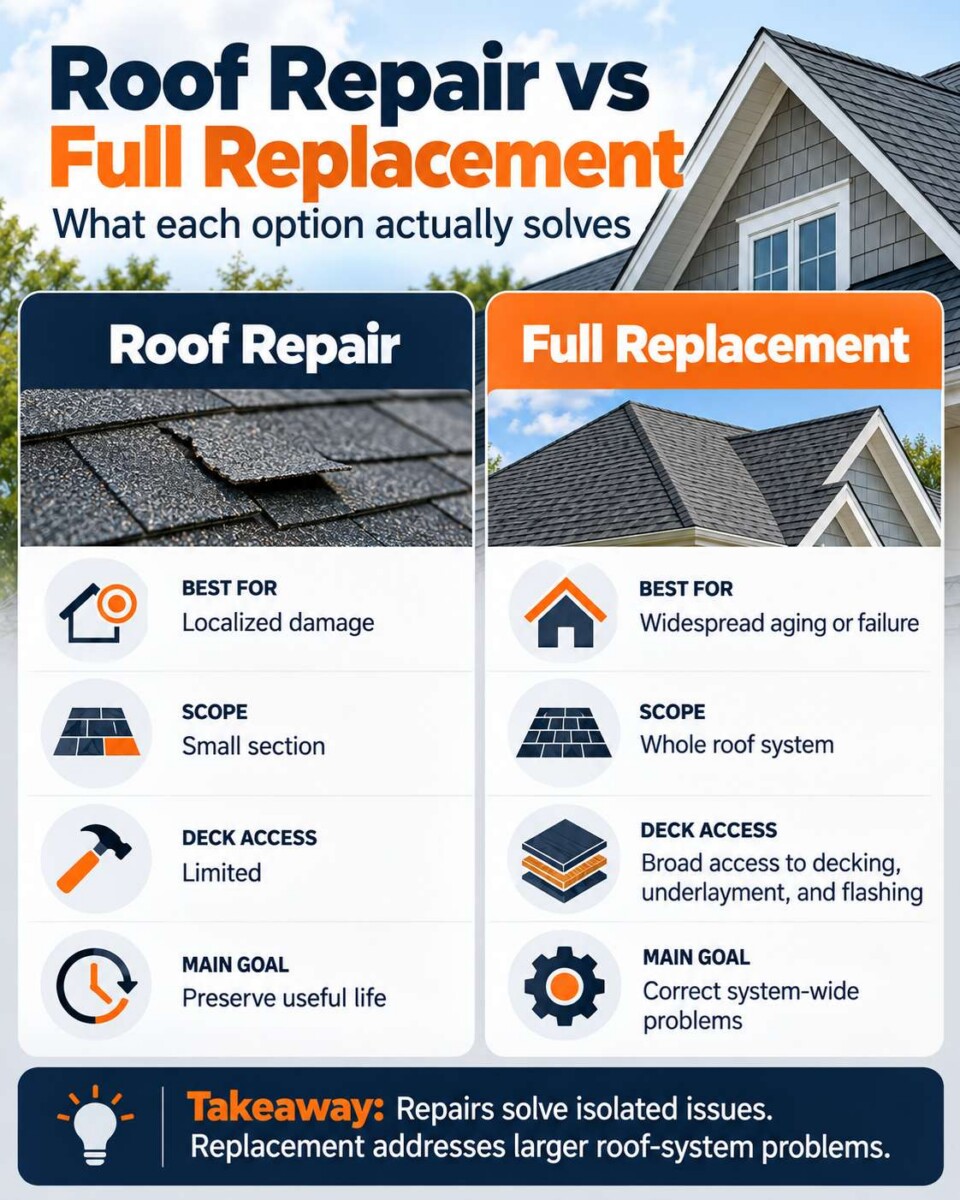
A roof repair fixes a limited problem while keeping most of the existing roofing system. A full roof replacement removes much more of the old system and gives the contractor access to decking, underlayment, flashing, and other parts that may also need work.
| Factor | Roof Repair | Full Roof Replacement |
| Best use | Localized damage | Widespread aging or failure |
| Scope | Small section | Whole roof system |
| Deck access | Limited | Broad access |
| Upfront cost | Lower | Higher |
| Remaining life | Depends on existing roof | Starts a new service cycle |
| Main goal | Preserve useful life | Correct system-wide problems |
Partial replacement or reroofing may work in some situations, but shingle matching, old roof layers, flashing details, and deck condition can limit those options.
How Should Roof Age and Michiana Housing Stock Affect the Decision?
Roof age helps estimate remaining service life. Many 3-tab asphalt shingle roofs fall around the 15 to 20 year range, while architectural shingles can often last longer. Actual life depends on installation, ventilation, weather exposure, and maintenance.
Parts of Elkhart, Goshen, and Granger include housing built during the 1990s and 2000s. Some original roofs from those periods could now be entering later-life stages, which may help explain part of Michiana’s replacement-heavy demand.
Housing age is not roof age. A home built in 1998 may have received a new roof in 2018. Local building patterns offer useful context, but they cannot prove that older housing caused the 54% replacement share.
What Do Leaks, Shingle Condition, Decking, and Underlayment Reveal?
A roofer should determine how far the problem has spread and how deep it goes. A surface issue may be repairable. Moisture that has reached the deck, underlayment, insulation, or several parts of the house can point to a much larger problem.
Local Problems That Often Support Repair
A single flashing leak, failed pipe boot, a few missing shingles, or limited wind damage may be repairable when nearby shingles remain flexible and the deck stays dry and firm.
Signs the Whole Roof May Be Aging
Widespread curling, cracking, missing shingles, or granule loss across several slopes suggests the material is deteriorating as a system rather than at one isolated point.
Damage Below the Shingles Changes the Decision
Decking is the wood base supporting the roof. Underlayment sits between that deck and the shingles. Soft wood, rot, trapped moisture, or wet insulation means the problem has moved below the visible surface. A simple patch may no longer solve the source of the damage.
When Do Storm Damage, Previous Repairs, and Rising Costs Change the Math?
A repair becomes less attractive when each new problem buys less useful life. Storm damage, repeated leaks, and an aging roof can turn a cheap fix today into another repair bill next year.
According to the Michiana Roof Report 2026, 15% of requests involved storms or insurance, while 30% of annual demand arrived in March and April. After hail or strong wind, the full roof should be inspected instead of repairing only the first visible problem.
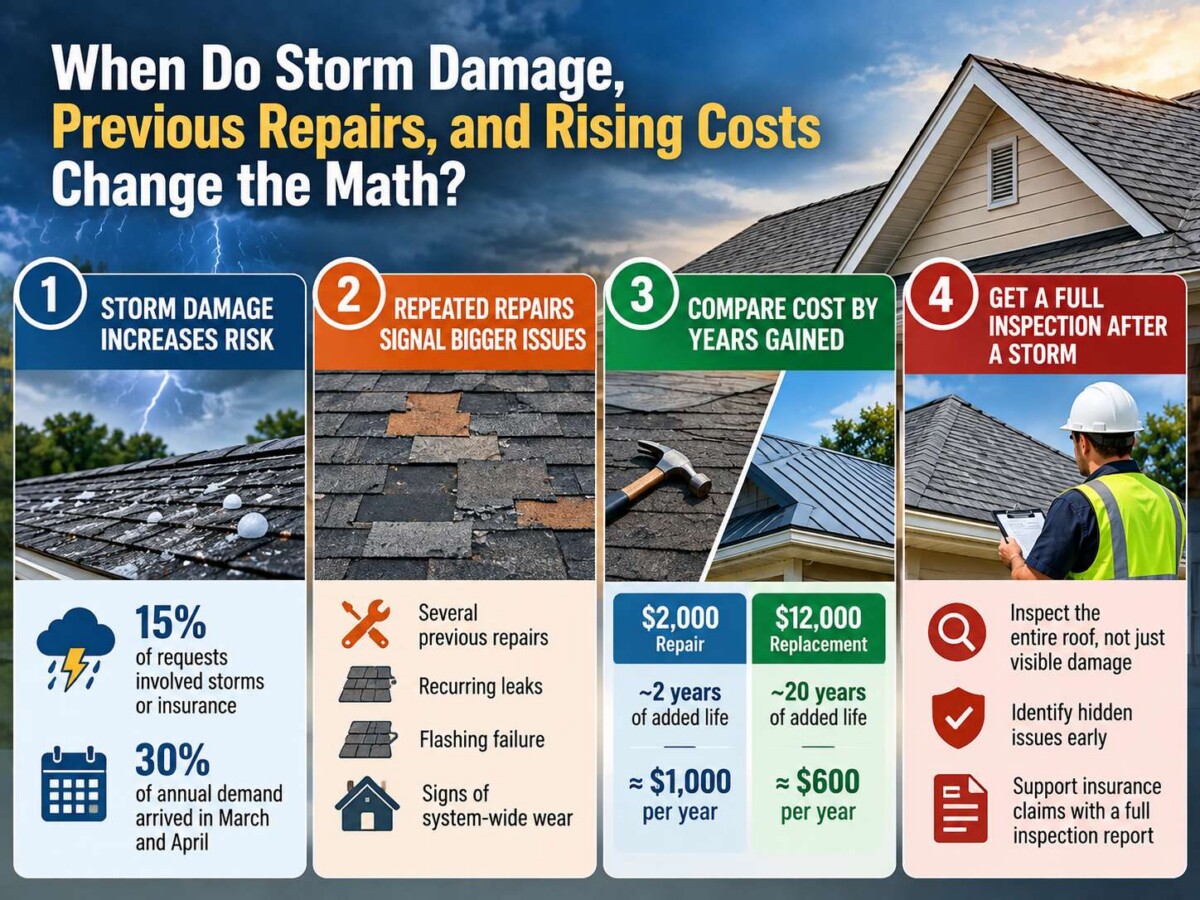
Repair history matters too. A roof with several patches in different areas may be showing system-wide wear.
Cost should be judged by years gained, so compare the roof replacement cost with what another repair is likely to buy you. If a hypothetical $2,000 repair only buys two more years, that equals about $1,000 per added year. A $12,000 replacement lasting 20 years equals about $600 per year before maintenance. The numbers will differ by home, but the method helps compare long-term value instead of sticker price alone.
Use the Michiana Roof Decision Framework: Repair, Replace, or Monitor?
The Michiana Roof Decision Framework turns the decision into six practical checks. Use them together. One age number, one leak, or one repair quote should not control the answer.
- Confirm the roof’s age and material. Find the installation date if possible and compare it with the normal service range for that roof type.
- Map the damage. One small problem supports repair more strongly than wear across several slopes.
- Check below the surface. Look for wet underlayment, soft decking, attic moisture, and poor ventilation.
- Review previous repairs. Repeated leaks or several patched areas reduce the value of another short-term fix.
- Compare cost with years gained. Ask how long a repair is realistically expected to extend service life.
- Add local and insurance context. Storm timing, insurance coverage, and Michiana demand matter, but they should modify the decision rather than make it.
A roof can therefore fall into one of three practical outcomes: repair now, monitor and plan, or replace.
What Should a Roof Inspection Confirm Before You Make the Final Call?
A useful inspection should answer more than “repair or replace.” It should explain what failed, how far the damage extends, whether moisture has reached deeper layers, and how much dependable life may remain.
Before making the final decision, ask the roofer to document:
- Roof age and material
- Shingle wear and missing areas
- Flashing around chimneys and penetrations
- Leak and moisture paths
- Decking condition
- Attic ventilation
- Previous repairs
- Storm damage
- Photos of important findings
- Repair and replacement options when both are realistic
The recommendation should explain why one option makes financial and technical sense.If replacement is likely, then understanding the best time to replace a roof in Indiana can help with timing, cost, and the next decisions.
Conclusion
Michiana homeowners request full replacement about 2.6 times as often as repair, according to the Michiana Roof Report 2026. That is useful local context, but it should not decide what happens to your roof.
An older roof can still qualify for repair when the problem is local and the system remains sound.
Use age, damage scope, underlying condition, repair history, remaining service life, and cost together, and if replacement is the outcome, compare metal vs. asphalt roofing before choosing the new roof system. That gives you a clearer answer than any single rule.
You May Also Want to Read
You may also want to read:
Storm Damage: Should You Call a Roofer or Your Insurance Company First?
What Does a New Roof Cost in Elkhart & Michiana?
FAQs
Can I Replace Just One Roof Slope or Half of My Roof?
Sometimes. Partial replacement can work when damage stays on one slope and compatible materials are available. Check flashing transitions, shingle matching, warranties, and the condition of the remaining roof. If several slopes are aging together, replacing one section may simply delay a larger project.
Does Homeowners Insurance Cover Roof Repair or Replacement?
It may cover sudden damage from events such as wind, hail, fire, or falling objects if your policy covers that cause of loss. Normal aging and wear are usually treated differently. Document the damage, check your deductible, and confirm coverage with your insurer before approving work.
Is Replacing a Roof Considered a Repair or a Home Improvement?
A full roof replacement is generally treated as a major property project rather than routine maintenance. Tax, insurance, appraisal, and accounting treatment can vary. Keep your invoices, permits, warranties, and installation records so the work can be documented later.
Should I Repair or Replace My Roof Before Selling My Home?
Look at the condition and sale timing. A sound roof with one local problem may need only repair. Widespread wear or little remaining service life can become an inspection or negotiation issue. Compare both options before listing the home.
Does a New Roof Increase Home Value?
A new roof can improve buyer confidence and remove a large near-term expense. The amount recovered varies by home and market. Replacement usually has the strongest financial case when the existing roof is already causing inspection, insurance, or buyer concerns.