

Roof insurance claims estimating in Indiana starts with proving what damaged the roof, measuring the affected areas, building the repair scope, and applying the terms of your insurance policy. The first estimate may change if valid damage or required work was missed. Your final payout can also depend on depreciation, your deductible, supplements, and completed repairs.
Introduction
A roof insurance claim should start with one question: Does filing make financial and practical sense? Before contacting your carrier, look at the likely cause of damage, your deductible, roof age, policy terms, and expected repair cost. Filing first and asking these questions later can leave you with a claim on record that provides little financial help.
Relentless Roofing Co. reports more than 1,000 successful Michiana storm-damage claims, 500+ denied claims overturned, and nearly $2 million recovered in previously uncompensated insurance funds. These are company-reported results published by Relentless Roofing Co.
Those cases point to a useful way of viewing the process. Think of your claim as an Indiana Roof Claim Lifecycle:
Coverage → Evidence → Estimate → Claim Review → Repair → Payment
Each stage affects the next. Weak evidence can affect the scope. Missing scope can affect the estimate. Policy valuation can affect the payment even after the insurer agrees that storm damage occurred.
Key Takeaways
Before filing a roof claim, confirm the damage is likely covered, well documented, and worth claiming after your deductible. Also check how your policy values the roof so you have a clearer idea of the possible payout.
- Cause: Was the damage caused by hail, wind, a falling object, or another covered event?
- Cost: Is the expected covered damage well above your deductible?
- Evidence: Do you have photos, storm dates, damage records, and receipts?
- Roof age: Could depreciation or a roof payment schedule reduce the payout? If your insurer is already pushing for replacement, read when your insurer says you need a new roof.
- Estimate: Does the insurance scope match the work your roof needs?
- Contract: Does your roofing agreement clearly list the work, price, and dates?
The Indiana Department of Insurance also recommends reviewing your policy, keeping records, estimating repair costs before the adjuster visit, and asking for an itemized settlement explanation.
How Roof Insurance Claims in Indiana Work From Damage to Final Payment
A roof claim is a series of separate decisions. Your insurance company decides whether the reported loss falls within the policy. The adjuster determines the insurer’s initial scope and estimate. Your roofing contractor determines what work the roof needs from a construction standpoint. The homeowner needs to compare those pieces before accepting the result.
That distinction matters because coverage, scope, and payment are different things.
An insurer may agree that hail damaged your roof but disagree about how many shingles require replacement. Both sides may agree on the repair scope while the policy still reduces payment because of depreciation. A contractor may also find damage after tear-off that was impossible to see during the first inspection.
This is why the first insurance estimate should be treated as a working document rather than a number you accept without review.
The best claim file tells a clear story: what happened, what was damaged, what work is required, what the policy covers, and how the final amount was calculated.
The 6-Step Indiana Roof Insurance Claim Process From Storm Damage to Payment
The Indiana roof claim process works best when each step supports the next. Good documentation proves the loss, accurate measurements support the scope, and complete repair records help close the claim and collect any remaining eligible funds.
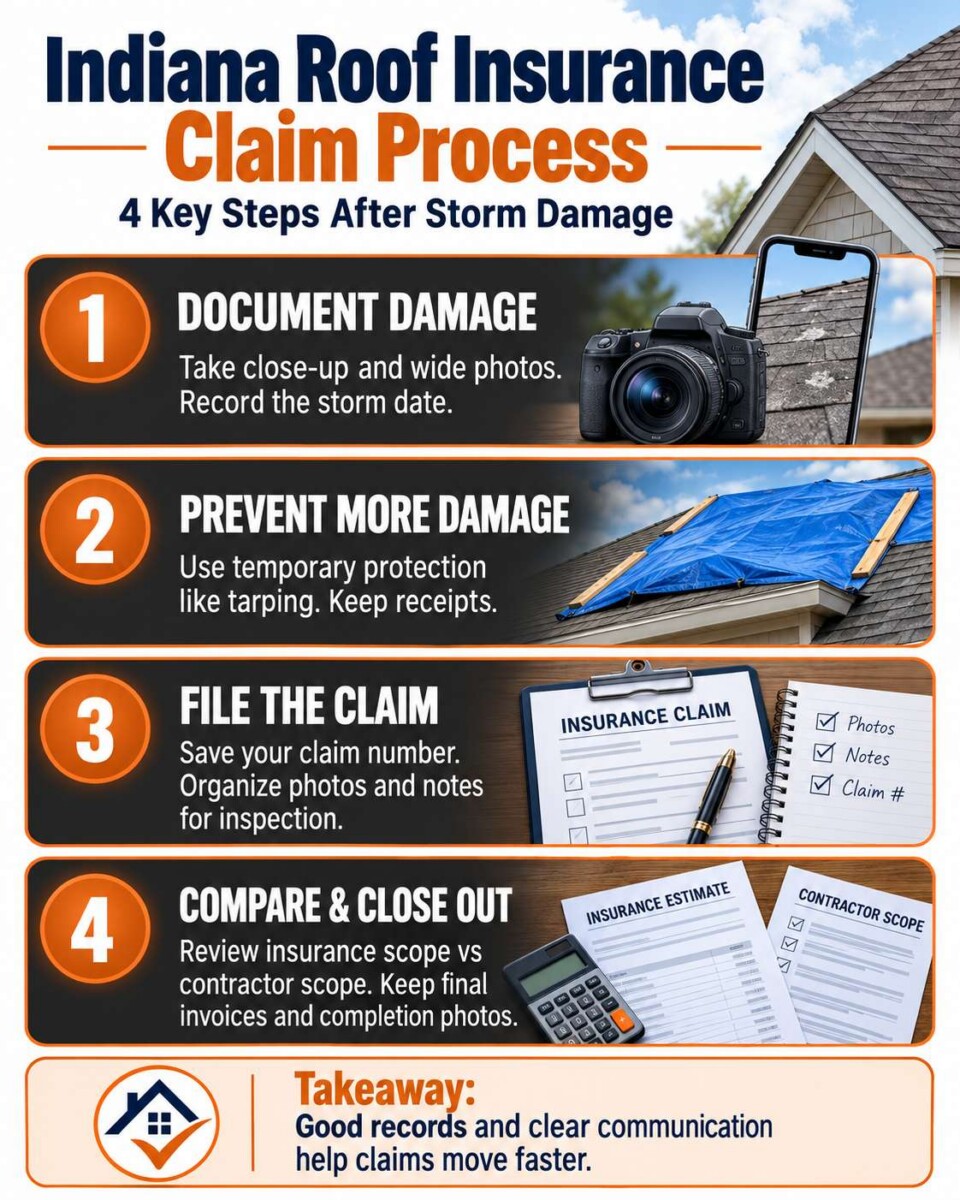
- Document the damage and storm date.
Take wide and close-up photos of shingles, flashing, gutters, vents, siding, and interior stains. Record the storm date and save local weather alerts or storm reports. - Prevent additional damage.
Use temporary measures such as tarping or controlling leaks. Photograph the damage first and keep all receipts. Avoid permanent repairs before the insurer has inspected the roof. - Check whether filing makes sense.
Compare the likely covered damage with your deductible. Also check the roof age and whether your policy uses ACV, RCV, or another valuation method. Learn more about filing a claim on an older roof. - Report the claim and prepare for inspection.
Save your claim number and keep a communication log. Organize photos, maintenance records, contractor findings, and temporary repair receipts. - Compare the insurance estimate with the contractor scope.
Look beyond the total price. Compare measurements, quantities, materials, labor, and any missing items. - Complete repairs and close the payment cycle.
Keep invoices, completion photos, supplement documents, and final records. These may be needed to recover eligible depreciation under an RCV policy.
Following these steps gives you a clearer claim record and makes it easier to spot missing scope, payment issues, or documentation gaps before they become larger problems. For more detail on each stage, see the step-by-step filing guide.
Is Your Roof Damage Covered—and When Should You Avoid Filing a Claim?
A damaged roof does not automatically create a valid insurance claim. Homeowners insurance usually covers damage from specific sudden events described in the policy. Aging, neglected maintenance, and long-term deterioration are different issues. Your first job is to identify the cause and compare the expected covered loss with your deductible and policy terms.
Wind, hail, falling trees, and similar sudden events may be covered, depending on your policy. Normal shingle aging, old leaks, poor installation, or neglected maintenance may be excluded.
The difficult cases sit between those two groups. A 17-year-old asphalt shingle roof can have normal wear and fresh hail or storm damage at the same time. Good photos and prior maintenance records help separate the pre-existing condition from the new loss.
Think twice before filing when:
- Repairs may cost less than or only slightly more than your deductible.
- You cannot identify a clear loss event.
- Most of the problem appears age-related.
- Your evidence cannot establish when the damage occurred.
- The financial benefit of a small claim appears limited.
This decision matters because IDOI says insurers may consider the number and value of prior claims when making homeowners policy renewal decisions. Carrier rules differ, but even relatively small claims may be considered.
How Adjusters Build a Roof Insurance Estimate With Xactimate, Measurements, and Line Items
A roof insurance estimate is built from three things: what work is needed, how much work is required, and what price is assigned to each item. Xactimate is commonly used to organize this work into line items, but the estimate can still be incomplete if the measurements or scope are wrong.
For roofing insurance claim estimating, the adjuster may consider roof area, pitch, facets, valleys, ridges, waste, material type, tear-off layers, flashing, vents, underlayment, disposal, and labor.
Why does this matter?
Suppose the insurance estimate includes 28 squares of shingles, while the contractor measures 31 squares. That creates a clear three-square difference that can be reviewed. The same applies to missing flashing, extra tear-off layers, ventilation, starter shingles, ridge material, or damaged decking.
A supplement is a request to revise the estimate when covered work or cost was missed, changed, or could not be confirmed during the first inspection.
A strong supplement should answer:
- What item is missing or incorrect?
- Why is it needed?
- What evidence supports it?
This gives the insurer a clear reason to review the estimate instead of simply receiving a higher contractor total.
ACV vs. RCV: How Roof Insurance Payouts and Depreciation Work in Plain English
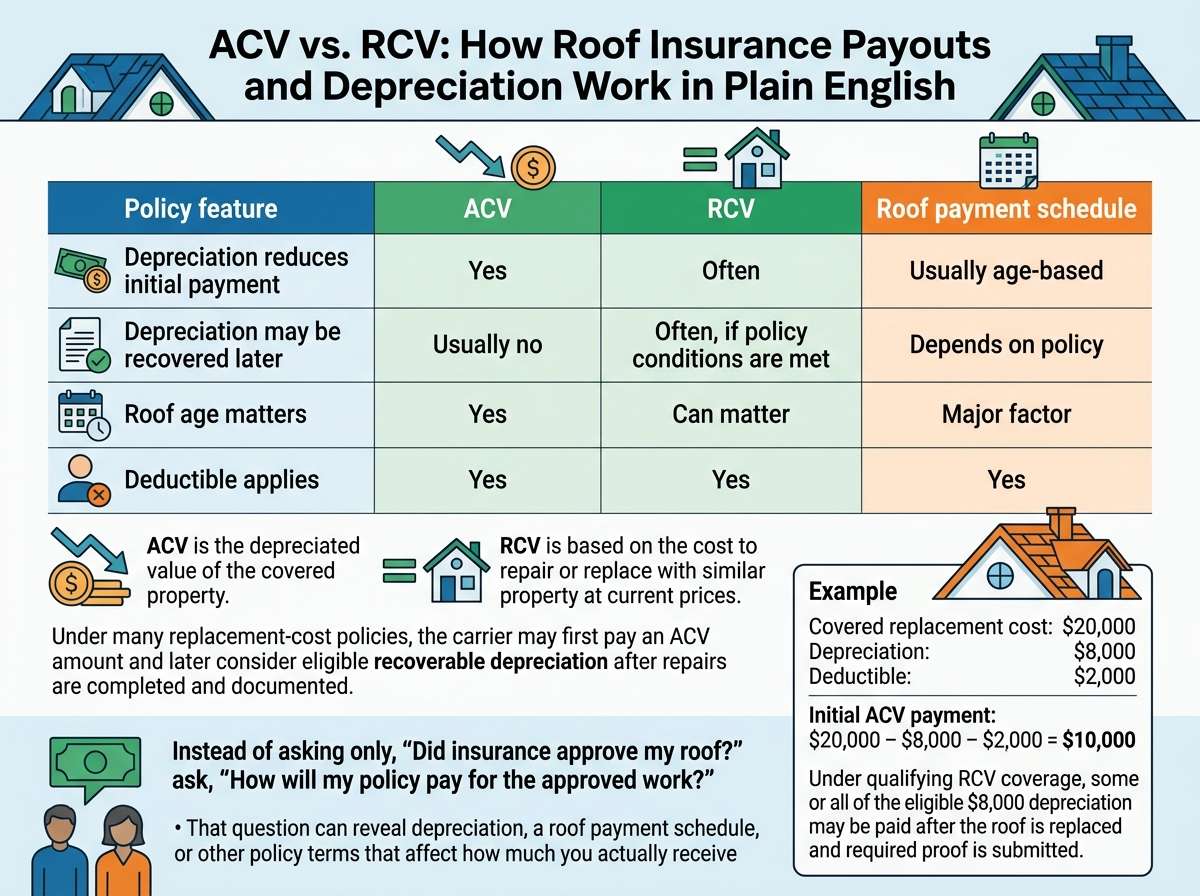
ACV and RCV determine how the insurer values covered property. Actual Cash Value generally subtracts depreciation. Replacement Cost Value generally reflects the current cost to repair or replace with similar property, though payment may occur in stages. Your deductible still applies, and roof-specific endorsements can change the calculation. If you received a check for a roof that still looks fine, read what to do with an ACV check on a sound roof.
| Policy feature | ACV | RCV | Roof payment schedule |
| Depreciation reduces initial payment | Yes | Often | Usually age-based |
| Depreciation may be recovered later | Usually no | Often, if policy conditions are met | Depends on policy |
| Roof age matters | Yes | Can matter | Major factor |
| Deductible applies | Yes | Yes | Yes |
ACV is the depreciated value of the covered property. RCV is based on the cost to repair or replace with similar property at current prices. Under many replacement-cost policies, the carrier may first pay an ACV amount and later consider eligible recoverable depreciation after repairs are completed and documented.
Example:
- Covered replacement cost: $20,000
- Depreciation: $8,000
- Deductible: $2,000
Initial ACV payment: $20,000 − $8,000 − $2,000 = $10,000
Under qualifying RCV coverage, some or all of the eligible $8,000 depreciation may be paid after the roof is replaced and required proof is submitted.
Instead of asking only, “Did insurance approve my roof?” ask, “How will my policy pay for the approved work?”
That question can reveal depreciation, a roof payment schedule, or other policy terms that affect how much you actually receive.
How Roofing Companies That Handle Insurance Paperwork Help Protect the Claim Scope
Roofing companies that handle insurance paperwork can inspect damage, measure the roof, write a contractor estimate, document construction requirements, and support legitimate supplements. Their value is strongest where roofing knowledge is needed. Indiana law still places a boundary between construction support and acting as a public adjuster for the homeowner.
Inspection and Roof Measurement
A contractor can identify missing shingles, hail impacts, damaged flashing, ventilation issues, and other physical conditions. They can also prepare a roof measurement that gives the homeowner something concrete to compare with the adjuster’s numbers.
Estimate and Supplement Support
The contractor’s estimate should explain what it will actually take to complete the roof repair or replacement.
If the insurance estimate omits valid work, the contractor can provide photos, measurements, material information, or other construction records that explain the difference.
That is where a contractor estimate has the most value: it turns a vague disagreement into a specific scope issue. Here is how contractors read your insurance estimate.
Indiana Contract Safeguards
Indiana’s Home Improvement Contracts Act applies to qualifying residential real property improvement contracts with a price over $150.
Indiana also prohibits a real property improvement supplier from promising to pay or rebate an insurance deductible to induce a customer to sign, and the statute prohibits such suppliers from acting as public adjusters.
A homeowner should therefore expect a contractor to explain the roof, not promise what the insurance company must pay. Learn the signs for spotting door-to-door roofing scams.
Why Roof Claims Get Denied or Underpaid—and How to Reduce the Risk
A roof claim often runs into trouble because one part of the evidence chain is weak. The insurer may dispute the cause, timing, measurement, repair scope, or policy coverage. Finding the exact point of disagreement is more useful than sending more paperwork without knowing what issue that paperwork is supposed to prove.
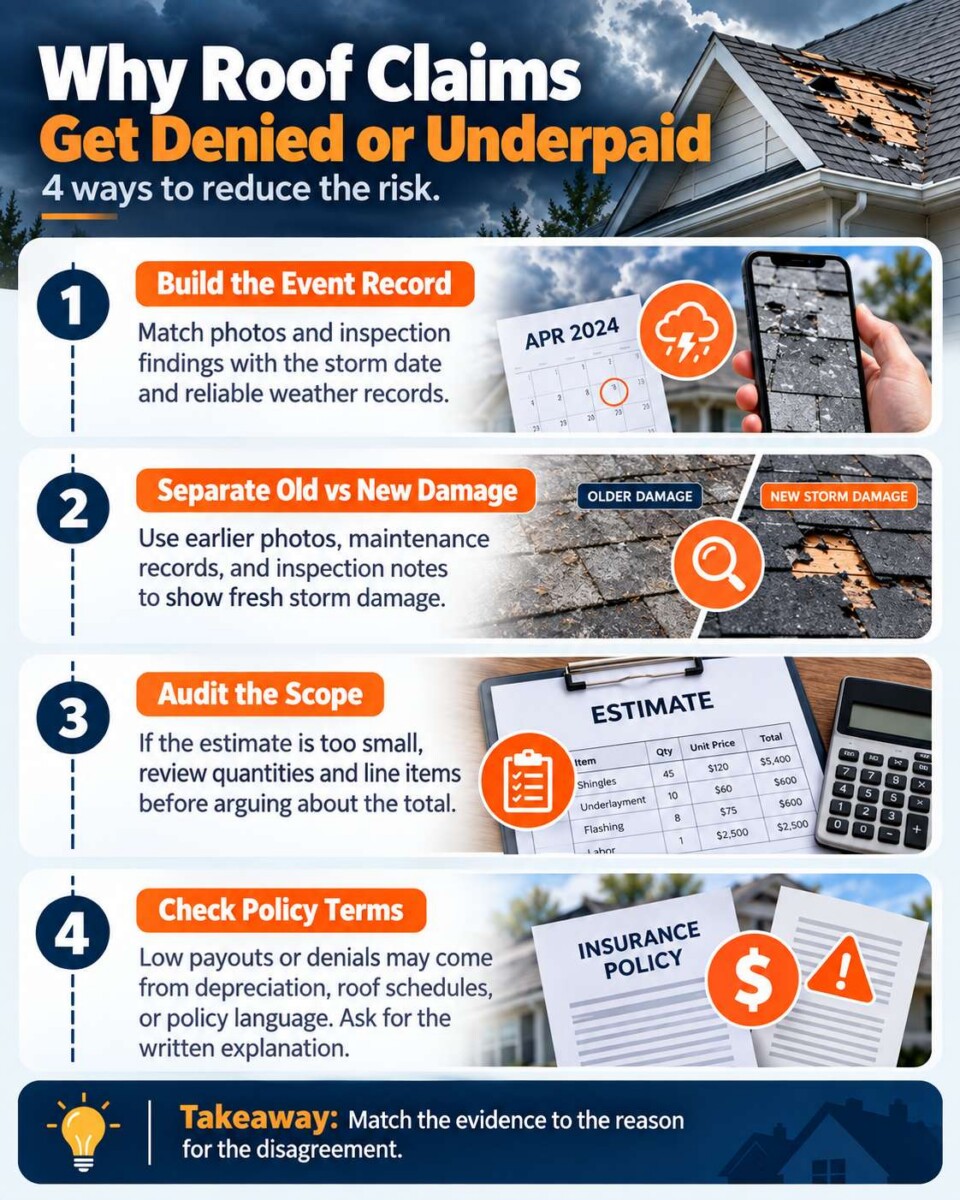
No clear storm date → Build the event record.
Match photos and inspection findings with the date the damage was first noticed and reliable storm information.
Insurer says wear and tear → Separate old from new.
Use maintenance records, earlier photographs, and inspection findings that identify fresh storm damage.
Estimate is too small → Audit the scope.
Check quantities and line items before arguing about the total.
Older roof produces a low payout → Check valuation terms.
The issue may be depreciation or a roof schedule rather than missing damage.
New damage appears during construction → Document before covering it.
Photograph hidden conditions and provide the evidence before the work removes the proof.
Claim is denied → Ask for the policy language.
IDOI tells consumers to request a written explanation of a denial and the specific policy provision used by the insurer.
The key principle is simple: match the evidence to the reason for the disagreement.
What to Do When the Adjuster and Roofing Contractor Disagree
An adjuster-contractor disagreement should be broken into measurable issues. Start with the least aggressive solution and move upward only if the problem remains. Most homeowners need to determine whether the dispute concerns measurements, damage, construction scope, pricing, or policy coverage before deciding what to do next.
- Compare both estimates line by line.
Mark every quantity or scope difference. - Ask why each difference exists.
A three-square measurement gap requires a different solution from a disagreement about whether flashing can be reused. - Provide supporting evidence.
Use photographs, roof measurements, invoices, material specifications, or other relevant records. - Request a supplement or reinspection.
Use this when valid covered work appears to be missing or the first inspection did not capture the full condition. - Consider independent claim help.
A licensed public adjuster may be an option for a larger disputed claim. A roofer and public adjuster perform different roles under Indiana law. - Use the Indiana Department of Insurance complaint process when appropriate.
IDOI says homeowners should first try to resolve the problem with the insurer. If that fails, the consumer may file a complaint with supporting documents. Once IDOI sends the complaint to the insurance company, the insurer has 20 business days to respond in writing.
That creates a clear escalation path:
Scope Review → Documentation → Supplement → Reinspection → Independent Help → IDOI Complaint
Roof Insurance Claims in Elkhart, Goshen, and the Michiana Communities We Serve
Roof insurance claims in Elkhart and Goshen follow the same Indiana insurance and contract rules, but the physical claim still depends on the individual storm, roof, policy, and damage. Local knowledge becomes useful when identifying storm patterns, roofing systems, material availability, measurement issues, and repair requirements across Michiana.
For roof insurance claims Elkhart homeowners should focus on getting the roof measured correctly and comparing the contractor’s scope with the insurance estimate.
For roof insurance claims Goshen IN homeowners should also build a clear storm record, especially where hail or wind damage may overlap with an older roof.
Relentless Roofing Co. lists service across these ten Michiana communities:
Elkhart • Goshen • Bristol • Middlebury • Nappanee • Wakarusa • Granger • Osceola • Mishawaka • South Bend
The company also reports 1,000+ successful storm-damage claims across Michiana.
This page works best as the main insurance-claim hub, while local pages can answer city-specific questions about inspection, repair, roof replacement, and recent storm damage.
Conclusion
A strong Indiana roof claim follows a clear order: identify the cause, check whether filing makes sense, document the damage, understand your coverage, compare estimates, support valid supplements, complete the work, and track the final payment.
Do not judge your claim only by whether insurance says “approved.” Check what was approved, how it was measured and priced, what depreciation was applied, and what you need to do to receive any remaining funds.
Keep your policy, photos, adjuster estimate, contractor estimate, supplements, HICA contract, invoices and payment records together. This gives you one clear record of the Indiana Roof Claim Lifecycle, from the first storm inspection through the final insurance payout.
FAQs About Roofing Insurance Claim Estimating in Indiana
These questions cover the points where homeowners are most likely to need a clear answer about estimates, payouts, documentation, and disagreements during a roof insurance claim.
How Do Insurance Adjusters Estimate a Roof Damage Claim?
Adjusters identify covered damage, measure the affected roof, choose repair or replacement line items, apply unit pricing, and then apply policy terms such as depreciation and deductibles. Software such as Xactimate may help structure the estimate, but accurate measurements and a complete scope still depend on the information entered.
Why Can an Adjuster’s First Roof Estimate Be Lower Than the Actual Repair Cost?
The first estimate may use different roof measurements, quantities, materials, labor items, or damage findings. Some hidden damage may also appear after work begins. Compare the contractor and insurance scopes line by line to find the exact source of the difference before requesting a change.
What Should I Do if My Contractor Estimate Is Higher Than the Insurance Estimate?
Ask the contractor to identify each difference instead of submitting only a higher total. Compare roof area, waste, shingle type, tear-off, flashing, ventilation, labor, disposal, and other line items. Provide supporting documentation for valid covered work that is missing from the insurance estimate.
What Documentation Do I Need to Receive the Full Roof Insurance Settlement?
Keep damage photos, storm information, inspection records, estimates, temporary repair receipts, invoices, supplements, completion photos, and insurer communications. Under an RCV policy, proof of completed repairs may be required before eligible recoverable depreciation is released. Follow the payment requirements stated in your own policy.
How Does Depreciation Affect an ACV or RCV Roof Claim Payout?
Depreciation reduces the value assigned to older property. Under ACV coverage, that reduction can lower the claim payment. Under qualifying RCV coverage, eligible withheld depreciation may later be recovered after repairs are completed. Roof-specific schedules or endorsements can change the calculation, so review them before estimating your final payout.