

If your insurance sent you a check for roof damage, do not treat it as the final payout. Check the settlement estimate, deductible, depreciation, payees, and approved work. The check may be only the first payment, and more money may depend on completing the work and sending proof.
Introduction
A roof insurance check means your roof insurance claim has reached the payment stage. Before using the money, the homeowner should review what the insurance company has approved, what the check covers, and whether additional funds may still be available.
Many roof insurance claims are paid in stages. The first check may be based on Actual Cash Value, or ACV, after depreciation and your deductible are applied.If your policy provides Replacement Cost Value, or RCV, you may receive a second check for recoverable depreciation after the approved repair or roof replacement is completed.
A mortgage lender may also be named on the insurance check. In that case, the lender may help control how and when the claim funds are released for the roofing work.
Key Takeaway
Before moving any money, check these points:
- Is the payment ACV, RCV, or part of a two-check claim?
- What deductible and depreciation apply?
- Is the depreciation recoverable?
- Is your mortgage company named on the check?
- Does the insurance scope match the roofing work?
- What proof is needed for the final payment?
Treat the money as part of the claim, not spare cash.
Why Is the First Roof Insurance sent me a Check Often an ACV Payment, Not the Full Payout?
The first roof insurance check is often based on Actual Cash Value, or ACV. In a roof insurance claim, ACV is the estimated replacement cost after depreciation is deducted. Your deductible can then reduce the amount the insurance company sends in the first check.
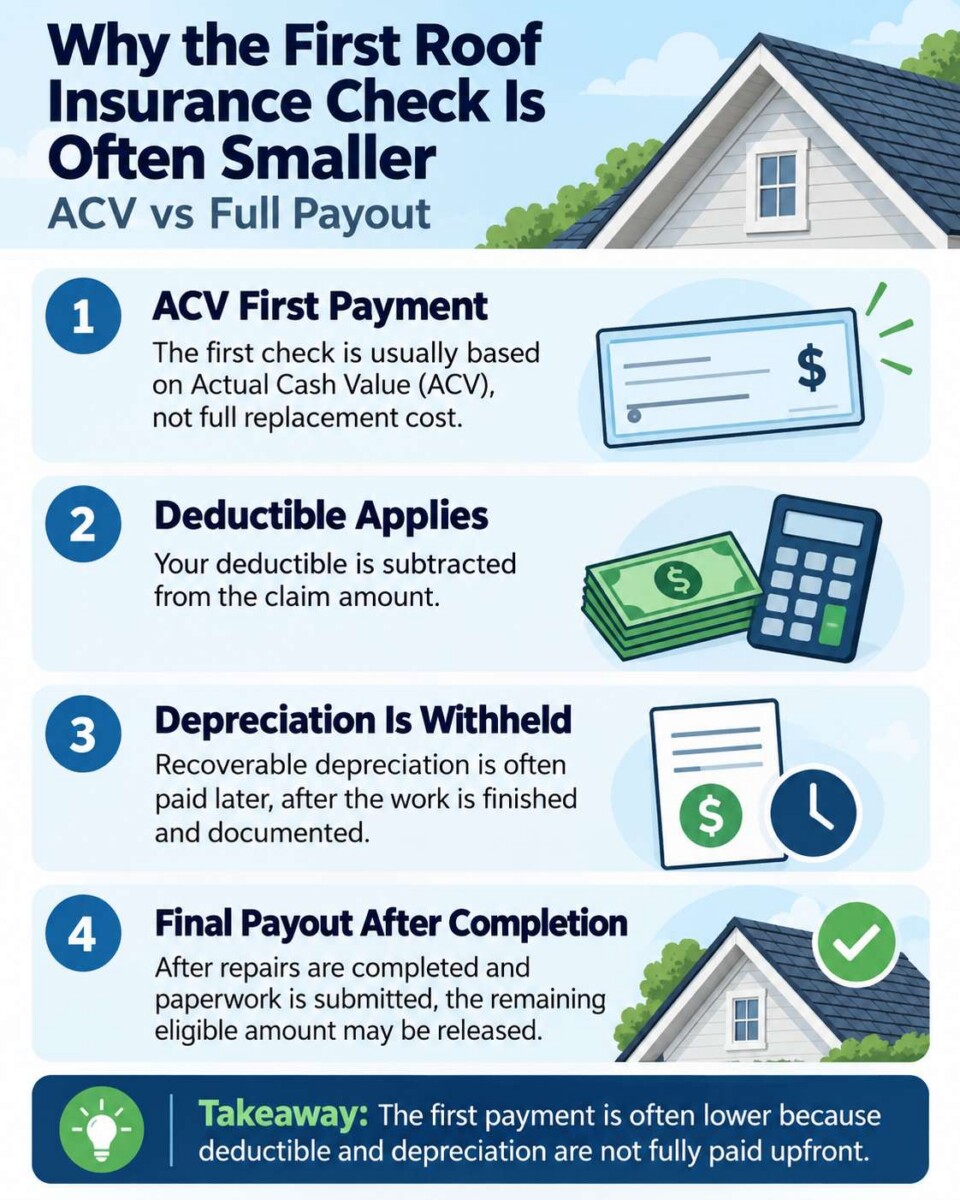
Replacement Cost Value, or RCV, is the estimated cost to repair or replace the covered roof. Depreciation reflects the loss in value caused by the roof’s age, condition, and expected useful life. Recoverable depreciation is the amount the homeowner may receive later after the approved roof repair or roof replacement is completed and documented.
A simple example:
| Claim Item | Amount |
| Replacement Cost Value | $25,000 |
| Depreciation withheld | $8,000 |
| ACV | $17,000 |
| Deductible | $2,500 |
| Initial insurer payment | $14,500 |
If the full $8,000 is recoverable, the insurance company may release it as a second check after the roofing work is completed and the required documents are submitted. Total insurer payments could then reach $22,500, while the $2,500 deductible remains the homeowner’s share.
Follow the Roof Claim Money Flow: Check → Deductible → Work → Invoice → Depreciation Recovery
Follow the roof insurance claim money in the right order so you know what has been paid, what you still owe, and what funds may still be available.
- Review the insurance check and insurance estimate. Confirm the RCV, ACV, deductible, depreciation, and net payment shown by the insurance company.
- Plan for the deductible. This is the homeowner’s share of the covered loss and usually must be accounted for before the roof repair or replacement is fully funded.
- Match the roofing contract to the approved scope. Check materials, quantities, tear-off, flashing, underlayment, permits, and other listed roofing work before agreeing to the project.
- Complete the approved work. Keep photos, contracts, receipts, and change orders throughout the repair process.
- Get the final roofing invoice. It should show the work completed, final project cost, and any approved changes.
- Submit proof to the insurance company. The final invoice and supporting records may be required before recoverable depreciation is released.
- Track the remaining payment. Confirm whether a second check, recoverable depreciation, or funds held by a mortgage lender are still outstanding.
The typical flow is:
RCV → depreciation withheld → deductible applied → first ACV payment → roofing work → final roofing invoice → depreciation request → final payment
If the roofing contractor’s estimate is higher than the current roof insurance claim, compare both scopes before approving added costs.
Before You Deposit the Check, Match It to Your Policy, Roof Scope, and Mortgage Requirements
Before depositing the insurance check, confirm what the payment represents, what part of the roof insurance claim it covers, and who must endorse it.
Review your declarations page and roof endorsements first. Some insurance policies pay roof damage based on Actual Cash Value, or ACV, while others may use Replacement Cost Value, or RCV, or a roof payment schedule. Then compare the insurance estimate with the roofing contractor’s estimate to see whether the approved scope matches the needed roof repair or roof replacement.
Check the roof size, materials, underlayment, flashing, tear-off, ventilation, permits, code-required work, and other damaged components.If the roofing contractor finds covered work that the adjuster missed, the insurance claim may need a supplement.
A supplement asks the insurance company to add or correct covered costs using proof such as photos, estimates, or code requirements.
If your mortgage company is listed on the check, contact the lender before setting payment dates with the roofer. The lender may need to endorse the insurance check, hold claim funds in escrow, or release the money in stages as the repair process moves forward.
Never Sign Over Your Roof Insurance Check Blindly: AOB and Roofer Payment Red Flags
Do not sign over your insurance check or claim rights just because a contractor says it is standard.
An Assignment of Benefits, or AOB, can transfer certain insurance rights to a third party. Its effect depends on the document and local law, so read it carefully before signing.
Watch for these red flags:
- The roofer wants the entire check before work starts.
- You are asked to sign a blank or incomplete form.
- The contractor says your deductible can simply disappear.
- The contract has no clear project price or payment schedule.
- The roofer wants control of all insurance proceeds.
- You are pressured to sign an AOB without a clear explanation.
- The contractor refuses to give you a copy of the agreement.
Tie payments to the written contract and agreed milestones. Endorsing a joint check for your lender is not the same as assigning claim rights to a roofer.
What Must the Roofing Invoice Show Before You Request the Second Insurance Check?
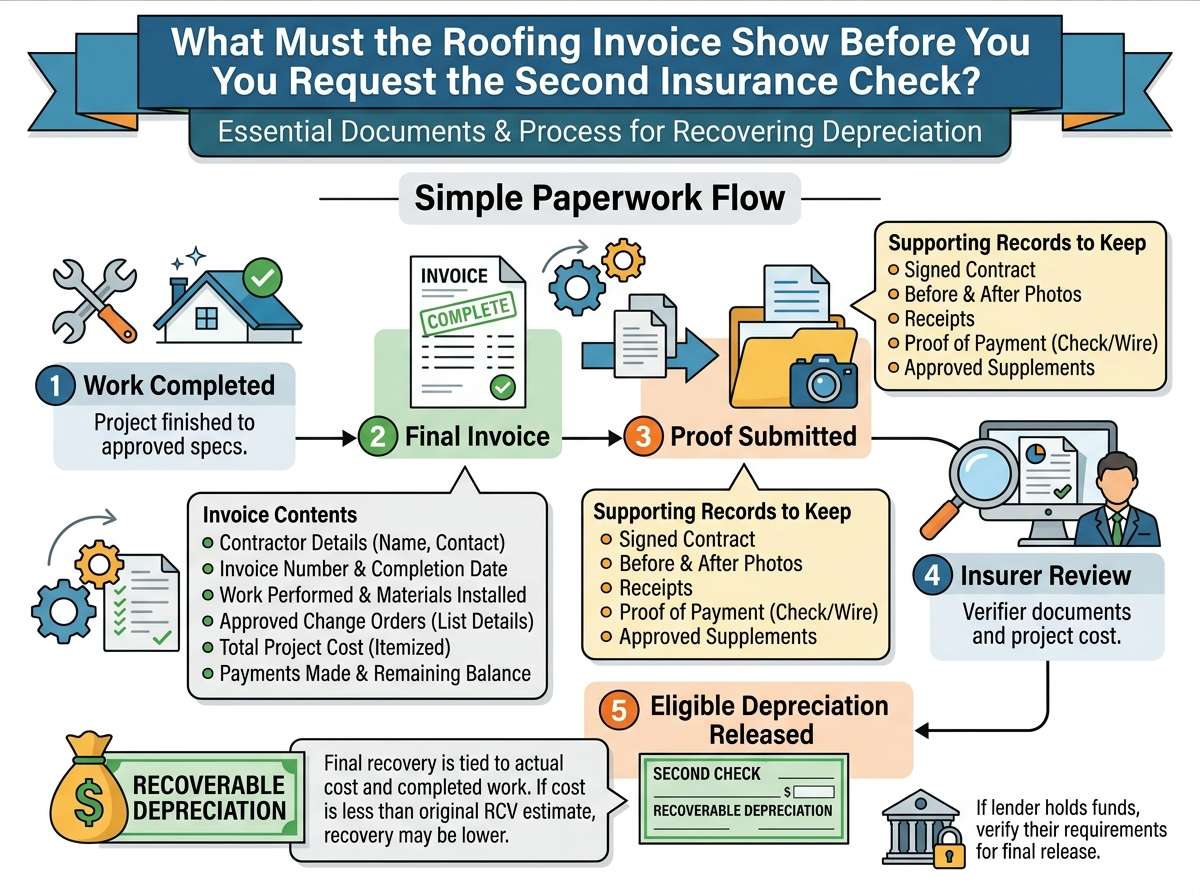
A roofing invoice for insurance should show who did the work, what was completed, the project cost, and the completion date.
It should normally include the contractor and property details, invoice number, completion date, work performed, materials installed, approved change orders, total project cost, payments made, and any remaining balance.
Keep supporting records such as the signed contract, photos, receipts, proof of payment, and approved supplements.
The invoice matters because recoverable depreciation is usually tied to completed work and actual cost. If the project costs less than the insurer’s estimated RCV, the final recovery may also be lower.
The paperwork flow is simple:
Work completed → final invoice → proof submitted → insurer review → eligible depreciation released
If a lender is holding funds, ask what it needs before releasing the final amount.
Can I Keep Insurance Money for My Roof? What Happens If You Pocket It or Delay Repairs?
Whether you can keep insurance money depends on your policy, lender rights, payment type, and local rules. More important is what you may lose by not completing the work.
With an ACV-only claim, there may be no later depreciation payment. With RCV coverage, skipping the repair can mean losing recoverable depreciation.
Delay can also make a future claim harder. Suppose the insurer paid for hail damage, but the roof still looks fine. Months later, the same area leaks. Old paid damage and possible new damage now have to be separated.
A mortgage company may also expect covered damage to be repaired.
The practical risk looks like this:
Money received → repair delayed → depreciation not recovered → damage remains → later costs rise → homeowner pays more
Before keeping claim money, confirm what the insurer considers paid, what funds remain available, what deadlines apply, and what your lender requires.
Conclusion
A roof insurance check is one step in the roof insurance claim process, not the finish line. Start by reviewing the ACV, RCV, depreciation, deductible, and every name listed on the check so you understand what the insurance company has paid and what may still be available.
Keep control of payments to the roofing contractor and read any AOB or insurance-related form before signing it. Make sure the final roofing invoice clearly shows the roofing work completed, actual project cost, and any approved changes needed for recoverable depreciation.
The goal is to complete the approved repair process, recover available claim funds, meet mortgage lender requirements, and close the roof insurance claim without an avoidable financial gap.
You May Also Want to Read
You may also want to read:
Roof Insurance Claim Denied in Indiana How We Have Overturned 500 Denials
Storm Damage Should You Call a Roofer or Your Insurance Company First
FAQs
Should I deposit a roof insurance check before hiring a roofing contractor?
You may be able to deposit it, but first confirm what the payment covers and who is named on the check. If a lender is a co-payee, its endorsement may be required. Depositing the check does not remove repair, documentation, or depreciation requirements.
What should I do if my mortgage company is also named on the insurance check?
Contact the mortgage servicer before paying the roofer. Ask what documents it needs, whether funds go into escrow, and whether payments are released in stages. Match the roofing payment schedule to that process.
Why is my roof insurance check smaller than the roofing estimate?
The first check may reflect ACV after depreciation and your deductible, while the roofing estimate may show the full repair cost. Compare both line by line. If covered work or code items are missing, ask whether a documented supplement is needed.
Do I still have to pay my deductible after insurance sends a check?
Yes, if your claim is subject to a deductible. The deductible is your share of the covered loss. Check the settlement summary so you know how much you must contribute to the project.
How long do I have to complete the work and recover depreciation?
There is no single deadline for every policy. Time limits can vary by insurer, state, and policy wording. Check your settlement documents and policy, then ask the carrier to confirm the deadline in writing.