

If your roof insurance claim was denied in Indiana, start with the reason in the denial letter. Then build evidence that answers that reason. Our Indiana Denial Reversal System uses inspections, storm records, policy terms, re-inspections, and escalation steps to decide whether a claim is worth challenging.
Introduction
When a roof insurance claim denied in Indiana, the insurance company is usually relying on policy language, its adjuster’s findings, and the evidence in the claim file. For an Indiana homeowner, the first step is to identify whether the claim denial comes from an exclusion, disputed roof damage, wear and tear, or missing documentation.
Our Indiana Denial Reversal System (IDRS) turns that reason into a clear response: diagnose the roof claim, document the damage, request another review when the evidence supports it, and escalate only when the facts justify the next step.
Key Takeaway
Before you appeal a denied roof claim, make sure you understand why the insurance company rejected it and whether stronger evidence can change the decision. An Indiana homeowner should answer five questions first:
- Why was the roof insurance claim denied?
- What policy language did the insurance company cite?
- What roof damage or supporting evidence is missing or disputed?
- What appeal or response deadline appears in the denial letter or insurance policy?
- Is the possible recovery worth the time, cost, and effort of continuing the claims process?
A strong appeal answers the exact reason for the claim denial with facts, photos, inspection findings, storm records, or policy language. A general “I disagree” response gives the insurer little reason to reconsider its decision.
Why Roof Insurance Claims Get Denied in Indiana and Which Denials Are Worth Fighting
Insurance companies usually deny roof claims because they believe the damage is old, excluded, unrelated to the storm, poorly documented, reported too late, or too limited. A decision is easier to challenge when new evidence can change the facts.
| Denial reason | When a challenge may make sense |
| Wear and tear | Storm damage can be separated from aging |
| Older roof | The policy still covers the storm loss |
| Late filing | Damage was hidden and useful evidence remains |
| Pre-existing damage | Earlier records show what changed |
| Documentation gaps | Missing proof can be added |
| Matching dispute | Material availability and policy wording support more scope |
IDRS rule: fight factual disputes with better facts. Test coverage disputes against the policy.
Read Your Roof Claim Denial Letter Like a Roadmap Before You Appeal
Your roof claim denial letter explains why the insurance company rejected or limited your claim. Before you appeal a denied roof claim, use that letter to identify the exact issue you need to challenge. Focus on the insurer’s findings, the insurance policy language it relies on, and any deadlines that may affect your next step.
Check the letter and claim file for:
- The exact reason for the claim denial
- The insurance policy section or exclusion being cited
- Statements about roof age, wear and tear, maintenance, prior damage, or storm damage
- Any deadline for an appeal, re-inspection, or response
- Photos, estimates, and notes from the insurance adjuster
- Differences between the adjuster’s findings and your roofing contractor’s inspection
- Any missing evidence that could better document the roof damage
Indiana does not use one universal internal appeal deadline for every roof insurance claim. The timing can depend on your insurer, policy, and denial letter. A separate Indiana rule gives certain residential property policyholders at least two years from the date of loss to bring suit against the insurer. That legal time limit is different from an insurer’s internal appeal deadline.
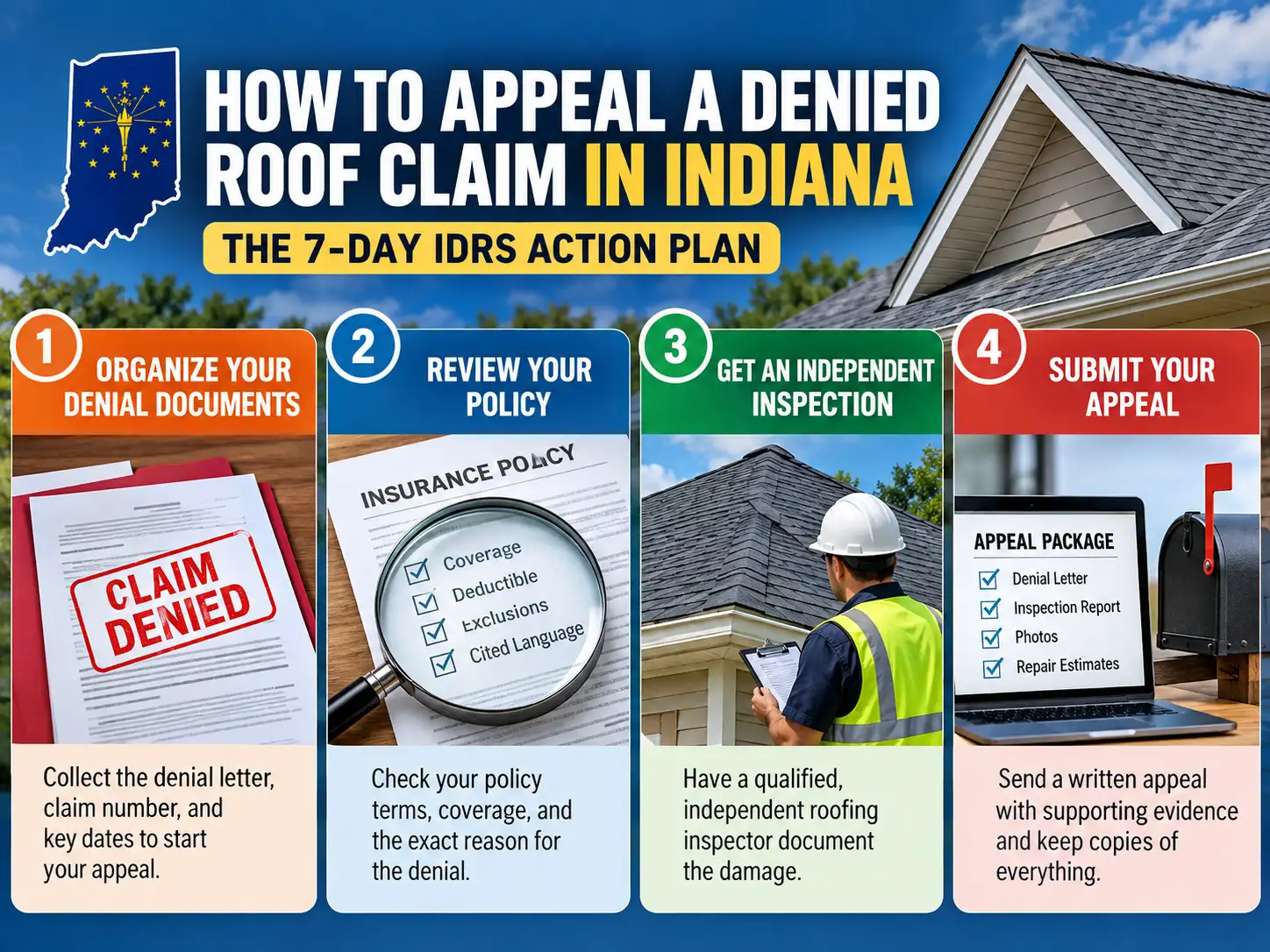
How to Appeal a Denied Roof Claim in Indiana: The 7-Day IDRS Action Plan
A strong appeal starts with evidence that directly answers the reason your roof insurance claim was denied. Use the first seven days to organize the claim file, document the roof damage, and decide whether an appeal or re-inspection is justified.
- Day 1: Save the denial letter and build a timeline of the storm, damage discovery, insurance claim, inspection, and denial.
- Day 2: Review your deductible, ACV or RCV terms, exclusions, and the policy language cited by the insurance company.
- Day 3: Schedule an independent roof inspection with a roofing contractor experienced in insurance claims.
- Day 4: Gather NWS or NOAA storm records, prior roof photos, maintenance records, interior damage photos, and repair receipts.
- Day 5: Match each piece of evidence to the exact claim denial reason.
- Day 6: Prepare a written appeal or request a re-inspection with your contractor present.
- Day 7: Submit the appeal and keep a written record of every response from the insurance adjuster or carrier.
Make temporary repairs when needed to prevent additional damage. Photograph the condition first and save every receipt. Avoid permanent repairs that could remove disputed evidence before the roof has been fully documented.
Build the Evidence Stack, Then Re-Inspect With Your Roofing Contractor Present
A re-inspection is more useful when your roofing contractor can show the insurance adjuster exactly what may have been missed, misclassified, or left out of the original roof inspection. The goal is to build a claim file that connects the visible roof damage to the reason your roof claim was denied.
Your evidence stack may include:
- Marked photos showing suspected hail damage, wind creases, missing shingles, or damaged roof slopes
- A written contractor report explaining the damage pattern and why it may be storm-related
- NWS or NOAA records confirming hail, wind, or other severe weather near the property
- Prior roof photos or inspection records showing the condition of the roof before the reported loss
- Maintenance and repair records that help answer neglect or wear-and-tear concerns
- ITEL or manufacturer data when roofing materials are discontinued or difficult to match
- An itemized estimate showing damage, measurements, and disputed repair or replacement scope
During the re-inspection, the contractor’s job is to document and explain the physical roof conditions. The insurance adjuster reviews that evidence under the insurance policy and claims process. Keeping both roles clear helps focus the discussion on the disputed facts instead of turning the re-inspection into another general inspection.
Match the Appeal Strategy to the Denial Reason Instead of Using One Generic Response
The evidence should change with the denial reason. This is the heart of IDRS.
Wear and Tear or Roof Age
Show normal aging and claimed storm damage separately. Side-by-side photos can help distinguish hail impacts or wind creases from gradual decline.
Late Filing
Build a discovery timeline. Show why the damage was not visible sooner and whether the roof can still be fairly investigated. Hidden damage, preserved shingles, leak paths, and storm records can matter.
Pre-Existing Damage
Use dated photos, prior inspections, repair records, or real estate images to show the roof’s condition before the reported loss.
Documentation Denial
Fill the gap. Missing storm proof calls for weather records. Unclear damage calls for better photos. Measurement disputes call for line-by-line comparison.
Matching or Partial Replacement
Do not assume Indiana automatically requires full matching. Use policy wording, material availability, ITEL findings, and repairability evidence to support the requested scope.
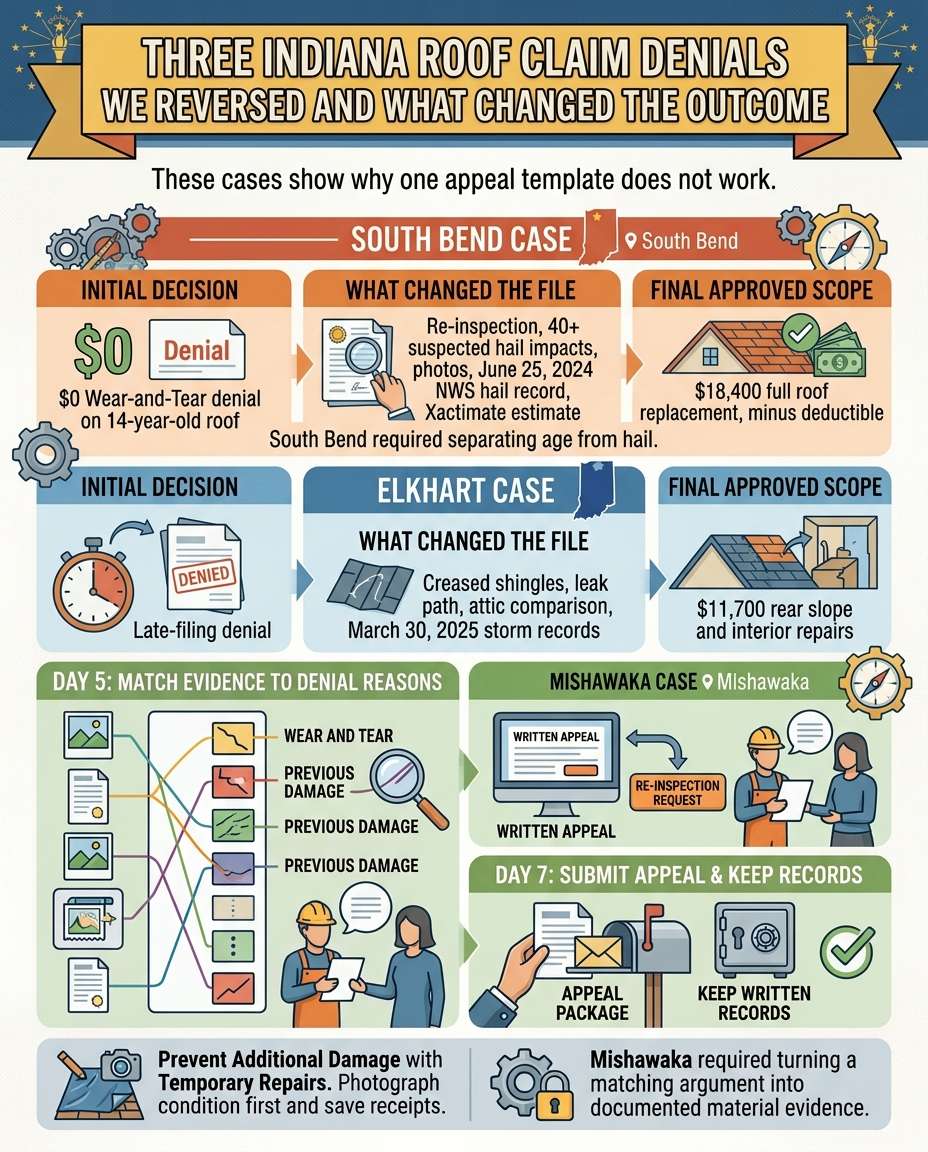
Three Indiana Roof Claim Denials We Reversed and What Changed the Outcome
These cases show why one appeal template does not work.
| Location | Initial decision | What changed the file | Final approved scope |
| South Bend | $0 wear-and-tear denial on 14-year-old roof | Re-inspection, 40+ suspected hail impacts, photos, June 25, 2024 NWS hail record, Xactimate estimate | $18,400 full roof replacement, minus deductible |
| Elkhart | Late-filing denial | Creased shingles, leak path, attic comparison, March 30, 2025 storm records | $11,700 rear slope and interior repairs |
| Mishawaka | About $6,300 for one slope | ITEL analysis, discontinued shingle proof, policy wording, storm records | $18,900 full roof replacement |
South Bend required separating age from hail. Elkhart required showing the loss could still be investigated. Mishawaka required turning a matching argument into documented material evidence.
When to Escalate a Denied Roof Claim to a Public Adjuster, Appraisal, Attorney, or Indiana Department of Insurance
Pick the next escalation step based on what remains disputed.
| Option | Best fit | Main limit |
| Re-inspection | Disputed roof damage | Needs stronger field evidence |
| Appraisal | Eligible amount-of-loss dispute | Policy controls when it applies |
| Public adjuster | Larger claim needing representation | Fee reduces net recovery |
| Indiana Department of Insurance complaint | Claim-handling concern | Regulator does not act as your attorney |
| Attorney | Contract rights or possible bad faith | Adds cost and time |
Start with re-inspection when the issue is what happened to the roof. Consider a public adjuster when claim value justifies the fee. File an IDOI complaint after trying to resolve a claim-handling issue with the carrier. Speak with an Indiana attorney when the dispute becomes a legal question. A denial alone does not prove bad faith.
When Fighting the Roof Claim No Longer Makes Financial Sense
A denied roof claim is not always worth pursuing. Before you spend more money, compare the amount still in dispute with your deductible, possible public adjuster or legal fees, inspection costs, and the time needed to continue the claims process.
Keep going when new evidence directly challenges the claim denial, the disputed amount is meaningful, and the insurance policy still supports coverage for the claimed roof damage. Reassess when the roof mainly shows long-term wear and tear, a clear policy exclusion applies, or the evidence cannot connect the damage to a covered storm event.
The Mishawaka case shows why the numbers matter. The original approved scope was about $6,300, while the final full-roof approval reached $18,900. That $12,600 difference justified further review. A small repair claim with a high deductible may be different. If the possible added recovery is low, continuing the dispute may cost more than it returns.
How to Reduce the Risk of Another Roof Insurance Claim Being Denied
Good records can make a future roof insurance claim easier to support. They help show the condition of the roof before a storm, when new roof damage appeared, and whether normal maintenance was being done.
To reduce the risk of another claim denial:
- Take dated roof photos each year from safe ground-level locations.
- Keep roof inspection reports, repair invoices, and maintenance records.
- Document the property after major Indiana hail, wind, or other storm damage events.
- Know whether your insurance policy pays roof losses on an ACV, RCV, or roof-age schedule.
- Report suspected damage promptly instead of waiting for a small problem to become worse.
- Avoid guessing about the cause of damage when you contact your insurance company.
- Save photos and receipts for temporary repairs made to prevent additional damage.
- Read roofing contractor agreements before signing anything connected to the claims process.
A clear pre-storm record can be especially useful in disputes over wear and tear, prior damage, maintenance, or roof age. It gives the insurance company and adjuster something concrete to compare with the condition of the roof after the reported loss.
Conclusion
A roof insurance claim denial should lead to a clear decision. Start with the insurance company’s exact reason, compare it with the insurance policy, roof inspection findings, and available evidence, then choose the next step that directly addresses the problem.
The Indiana Denial Reversal System (IDRS) keeps that process focused: diagnose the claim denial, document the roof damage, request a re-inspection when stronger evidence supports it, appeal with a clear purpose, and escalate only when the facts and possible recovery justify the added time and cost.
For homeowners, the goal is not to fight every denied roof claim. It is to know when the evidence supports another review and when moving on is the better financial choice.
You May Also Want to Read
You may also want to read:
Roof Insurance Claims in Indiana: Estimating, Filing and Payout Guide
When Is the Best Time to Replace a Roof in Indiana?
FAQs
How Long Do I Have to Appeal a Denied Roof Claim in Indiana?
There is no single Indiana internal appeal deadline for every carrier and policy. Check the denial letter and policy first. Treat any stated deadline as important. Indiana’s separate minimum two-year suit period for certain residential property policies should not be confused with an insurer’s appeal deadline.
What Should I Avoid Saying to a Roof Insurance Adjuster?
Avoid guessing about the storm date, cause, roof condition, or how long damage has existed. Give facts you can support. If you do not know, say you need to check your records. Let photos, dates, inspection findings, and receipts support the claim.
Are Some Carriers More Lenient on Roof Age and Storm Claims?
I cannot confirm a reliable Indiana ranking of carriers by “leniency.” Results depend on policy language, endorsements, roof condition, storm facts, and evidence. Compare roof coverage, deductibles, ACV or RCV terms, and age limits instead of assuming one insurer will approve claims more easily.