

Homeowners’ insurance pay may for a new roof when sudden damage comes from a covered event such as hail, wind, fire, or a fallen tree. There is no fixed claim limit. Each claim depends on the cause, roof condition, policy terms, deductible, prior claims, and roof value.
Introduction
Think of a roof claim as part of a Roof Claim Life Cycle: condition before the loss, storm damage, claim, payout, repair or replacement, then the next event. This approach helps homeowners judge each claim based on where the roof stands in its useful life.
A five-year-old roof with replacement cost coverage can produce a very different result from a 20-year-old roof covered at actual cash value. The same hailstorm may lead to full replacement, repair, or a smaller payment.
For Indiana homeowners, know your roof age, deductible, coverage type, and condition before severe weather arrives.
Key Takeaways
- Insurance usually pays for sudden covered damage, not aging or poor maintenance.
- There is no universal limit on roof claims, but repeated claims can affect renewal.
- Older roofs may be paid at actual cash value or through a roof payment schedule.
- Full replacement depends on covered damage and policy terms.
- A new roof may lower premiums, but savings vary by insurer.
When Will Insurance Pay for a New Roof? Start With the Cause of Damage
Insurance is more likely to pay for a new roof when a sudden, covered event causes direct damage. Common examples include hail, strong wind, fire, falling trees or debris, and some damage from snow or ice. Coverage still depends on your policy, deductible, exclusions, and the extent of the roof damage.
Roof age by itself is not a covered loss. Worn shingles, long-term leaks, rot, poor maintenance, animal damage, and faulty installation are usually treated as homeowner responsibilities. Standard homeowners insurance also commonly excludes flood and earthquake damage unless separate coverage applies.
Roof leaks follow the same basic rule. If wind damages shingles and rain enters through the opening, the resulting damage may be covered. If water enters because old flashing has slowly failed over time, the claim is less likely to qualify. In most cases, what caused the damage matters more than the damage itself.
How Often Will Insurance Pay for a New Roof? There Is No Hard Claim Limit
There is no standard rule that insurance replaces a roof only once every 10, 15, or 20 years. Separate covered events can support separate claims. Two separate damaging storms may each be reviewed as a new loss.
Indiana’s Department of Insurance says insurers may consider the number and dollar amount of prior claims when deciding whether to renew a homeowners policy. Each carrier may use different claim-history standards.
Before filing, check:
- Was there a covered event?
- Is the damage clearly documented?
- What will repairs cost?
- What is the deductible?
- Is the roof RCV, ACV, or scheduled?
- Have you filed other recent property claims?
A $15,000 hail loss is a different decision from a $1,500 repair with a $1,000 deductible. A small claim may provide little financial help while still becoming part of your claims history.
Do Insurance Companies Prorate Roof Replacement? How Roof Age Changes the Payout
Yes. Some insurance policies reduce roof payments as the roof ages. Actual cash value (ACV) accounts for depreciation. Replacement cost value (RCV) is based on replacing covered damage with comparable new materials, subject to the policy and deductible. A roof payment schedule uses preset percentages based on material and age.
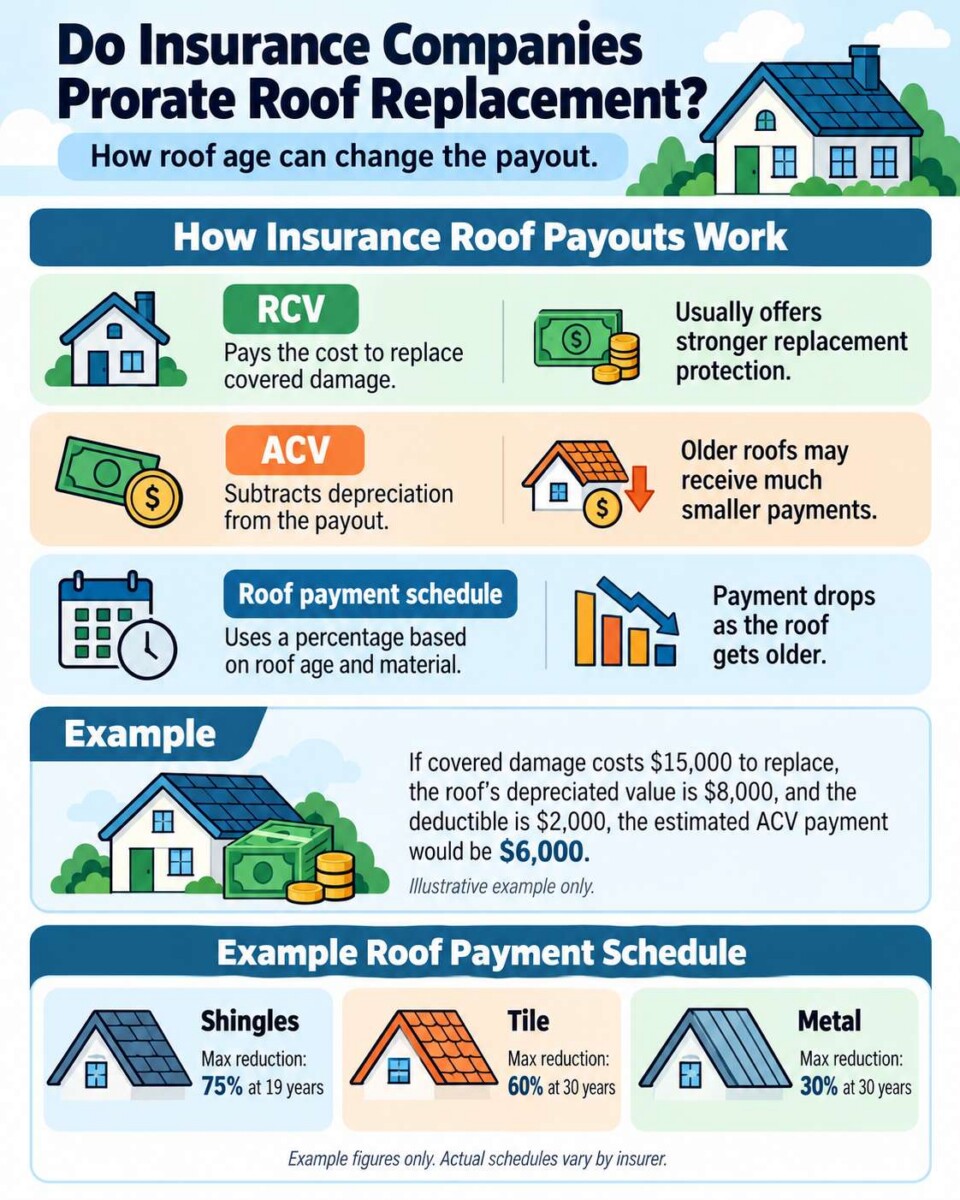
| Payout Method | How It Works | What It Means for You |
| RCV | Uses the cost to replace covered damage | Usually provides stronger replacement protection |
| ACV | Subtracts depreciation | Older roofs can receive much smaller payments |
| Roof payment schedule | Uses a percentage based on roof age and material | Payment falls as the roof ages |
For example, suppose covered damage costs $15,000 to replace. If depreciation leaves an ACV of $8,000 and your deductible is $2,000, the estimated payment becomes $8,000 – $2,000 = $6,000.
Kin’s published schedule shows how material can change the calculation. Its schedule reaches a maximum reduction of 75% for shingles at 19 years, 60% for tile at 30 years, and 30% for metal at 30 years. These are Kin’s figures, not a rule used by every insurer.
How Do You Give a Roof Replacement Claim the Best Chance of Being Paid?
A strong claim connects fresh damage to a covered event and gives the insurer clear evidence. Indiana’s Department of Insurance recommends prompt reporting, photos or video, records of temporary repairs, and an itemized settlement explanation.
- Review the policy. Check exclusions, deductible, and whether the roof is RCV, ACV, or scheduled.
- Document the damage. Photograph affected roof areas, gutters, vents, flashing, and indoor water marks where safe.
- Get a written inspection and estimate. Separate fresh storm damage from normal wear.
- File promptly. Follow your policy’s notice rules and keep copies of communication.
- Review the scope. Compare the adjuster’s estimate with the contractor’s documented work.
- Challenge gaps with evidence. If denied or underpaid, ask for the reason and policy language in writing.
Avoid permanent repairs before the insurer can inspect the loss unless work is needed to prevent further damage. Keep receipts for temporary repairs.
Indiana Hail Season: Why April Through June Matters for Your Roof Claim Strategy
Indiana sees frequent hail, damaging wind, and severe storms, with April through June being an important period for roof preparation. Hail can still occur outside these months, so homeowners should stay alert throughout storm season.
Before severe weather arrives, take dated ground-level photos of your roof and keep installation, inspection, and repair records. This gives you a clear record of the roof’s condition before a storm and can help separate new hail or wind damage from older wear.
After a storm, check for missing shingles, dented vents or flashing, damaged gutters, fallen branches, and new water stains inside the home. Avoid permanent repairs until the insurer has inspected the damage unless emergency work is needed to prevent further loss. Keep photos and receipts for any temporary repairs.
Does a New Roof Lower Insurance? What Can Change After Replacement
A new roof can lower homeowners insurance. The amount depends on the insurer, roof material, location, and rating rules.
A Newer Roof May Improve Pricing and Eligibility
ValuePenguin found that homes with brand-new roofs averaged 19% lower premiums than homes with 20-year-old roofs in its South Carolina quote study. The study compared annual rates of $2,211 for a new roof and $2,624 for a 20-year-old roof. This shows how roof age can affect pricing. It does not establish an Indiana-wide discount.
Impact-Resistant Roofing May Qualify for Discounts
Indiana Farm Bureau states that qualifying roofs meeting UL 2218 Class 3 or Class 4 impact testing can receive a policy premium discount.
Update Your Insurer After Replacement
Give your insurer the installation date, invoice, roofing material, and any impact-resistance certification. Ask whether the new roof changes your premium, recorded roof age, or available coverage.
When Insurance Will Not Pay for a New Roof: What Should You Do Next?
If your insurance company denies the claim or pays less than expected, start by finding out why. The reason may be your deductible, roof age, policy limits, excluded damage, or the way the insurer valued the roof. Once you know the cause, you can choose the right next step.
- The damage is close to your deductible: Compare the expected insurance payment with the repair cost before filing or continuing the claim.
- Age, wear, or poor maintenance caused the damage: Get repair and replacement estimates and plan to pay the cost yourself.
- ACV or a roof payment schedule reduced the payout: Ask for the full calculation so you can see the replacement cost, depreciation, deductible, and final payment.
- Covered damage appears underpaid: Compare the insurer’s scope with your contractor’s estimate and supporting photos. Pasted markdown
Missing work may support a supplement request.
- The roof needs replacement but is not covered: Compare cash savings, a personal loan, HELOC, and contractor financing based on total cost and monthly payment.
Insurance is meant to cover qualifying losses, not normal roof aging. Knowing why the claim was denied or reduced helps you decide whether to repair, challenge the settlement, finance the work, or plan for replacement.
Conclusion
Insurance can pay for a new roof more than once, but each claim is judged on its own. The cause of damage, roof age, policy type, deductible, and claim history all affect whether insurance will pay and how much you may receive.
Before filing, confirm the damage is likely covered and compare the expected payout with your deductible and repair or replacement cost. This can help you avoid a claim that offers little financial benefit.
After repairs or replacement, keep your photos, invoices, and inspection records. These documents can make it easier to prove new damage if another Indiana storm affects your roof later.
You May Also Want to Read
You may also want to read:
Should I Tell My Insurance Company About My New Roof
Storm Damage Roof Claims in Elkhart County: A Homeowners Timeline
Wikipedia Article on Property Insurance
FAQs
Will Insurance Cover a 10-Year-Old Roof?
Yes, it can. A 10-year-old roof may qualify when a covered event causes damage. Check the cause, roof condition, deductible, and whether the policy pays RCV, ACV, or a scheduled amount. Roof age affects the possible payout, but age by itself does not prove or disprove a storm claim.
How Long Does It Take for Insurance to Approve a Roof Replacement?
There is no single approval period for every roof claim. Timing depends on the insurer, inspection schedule, documentation, extent of damage, and any dispute over the estimate. Report the loss promptly and submit complete records because missing information can delay processing.
Will Insurance Replace My Entire Roof or Only the Damaged Section?
It depends on the covered damage and your policy. If an area can be properly repaired, the insurer may approve only that work. Wider damage, unavailable matching materials, applicable code requirements, and policy terms can affect whether the approved scope grows into a full replacement.
What Should I Do if My Roof Insurance Claim Is Denied or Underpaid?
Ask for the reason and policy language in writing. Compare the decision with your photos, inspection report, contractor estimate, and policy. Correct missing evidence first. Indiana homeowners can also file an insurance company complaint with the Indiana Department of Insurance when a dispute remains unresolved.