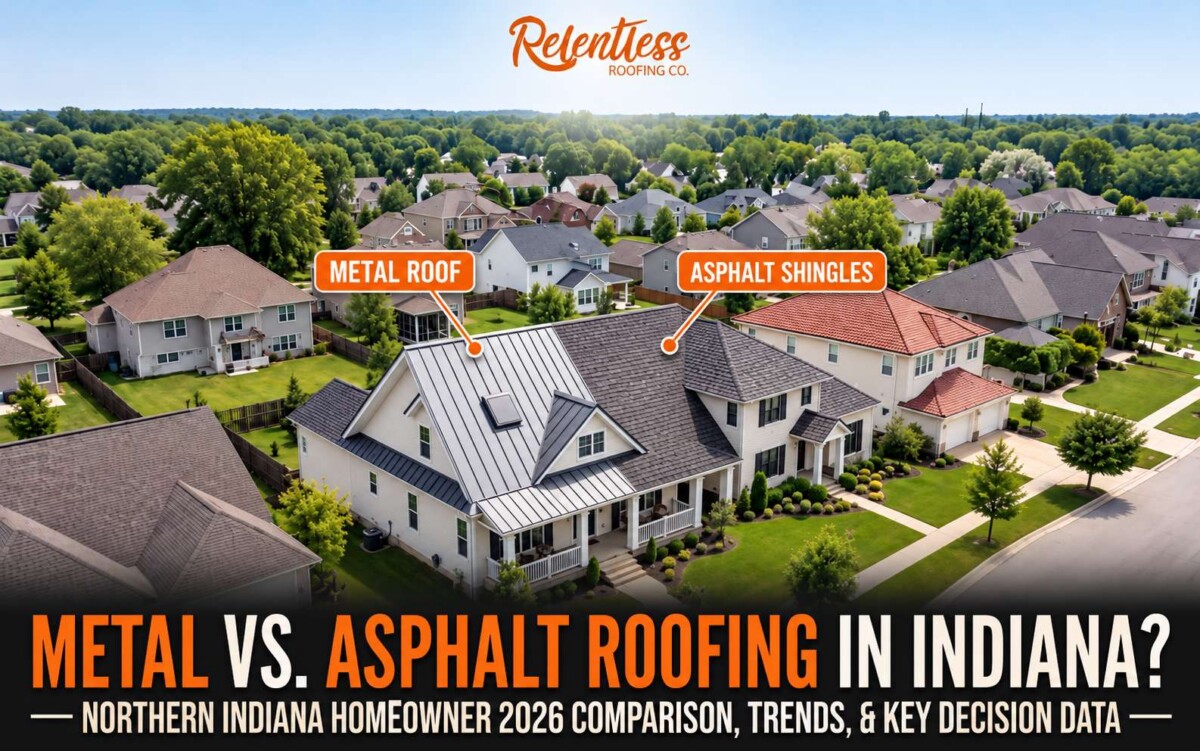
Quick answer: In Northern Indiana, asphalt shingles cost less upfront, are easier to repair, and last about 20 to 30 years. A metal roof costs about 1.5 to 2 times more but lasts about 40 to 80 years and sheds snow faster. Metal makes the most sense if you plan to stay 20 or more years; asphalt recoups more at sale.
Snow, ice, hail, wind, roof slope, attic conditions, and how long you plan to own the home all affect which roof fits. This guide compares both materials the way a Michiana homeowner should: cost over time, lifespan, resale return, snow and wind performance, noise, energy, and insurance, with sources for every figure.
Key Takeaways
- Asphalt shingles usually have a lower upfront cost and simpler repairs: $4.50 to $7.50 per square foot installed in Indiana (Relentless Roofing Co. estimate, 2026).
- Metal roofing usually costs more but can last much longer: $9 to $15 per square foot, with a life expectancy of 40 to 80 years (InterNACHI) versus 20 years for 3-tab and 30 for architectural shingles.
- At resale, an asphalt roof replacement recoups 69.2% of its cost and a metal roof 45.9% in our region (Cost vs. Value 2025, East North Central).
- Metal sheds snow faster. Asphalt tends to hold snow longer.
- Ice dams can affect either material when the attic loses heat or has poor insulation or ventilation.
- Architectural and UL 2218 Class 4 impact-resistant shingles perform much better than basic shingles.
- Standing seam metal has different maintenance needs than exposed-fastener metal.
- Your budget, roof design, weather exposure, and ownership timeline should guide the final choice.
What Is the Real Difference Between a Metal Roof and Asphalt Shingles?
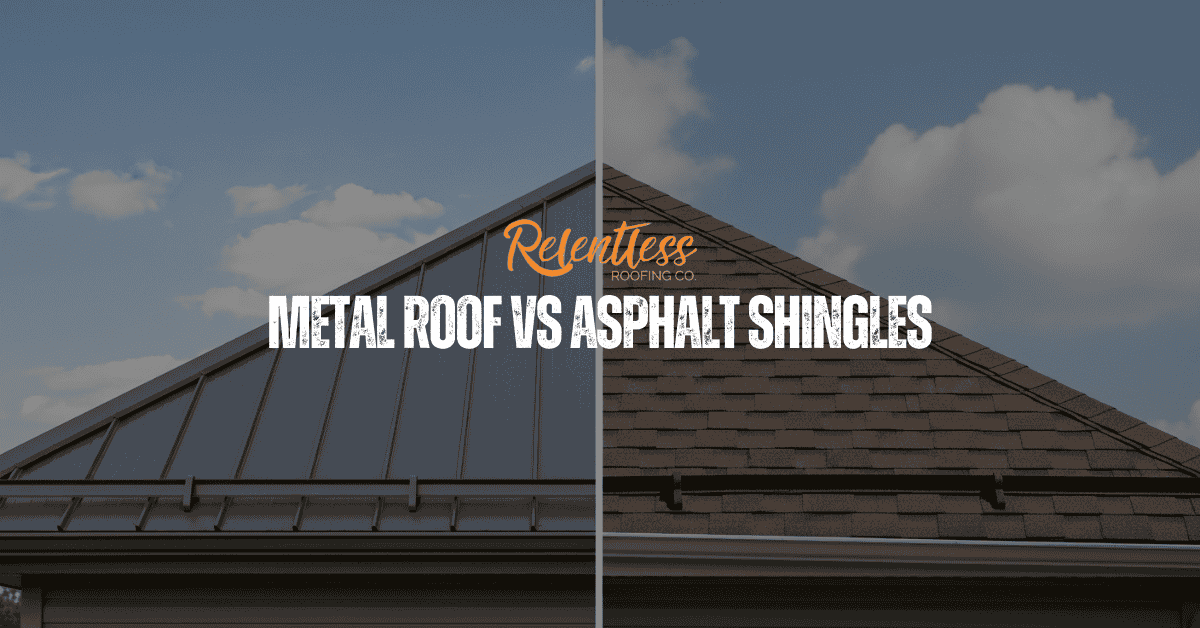
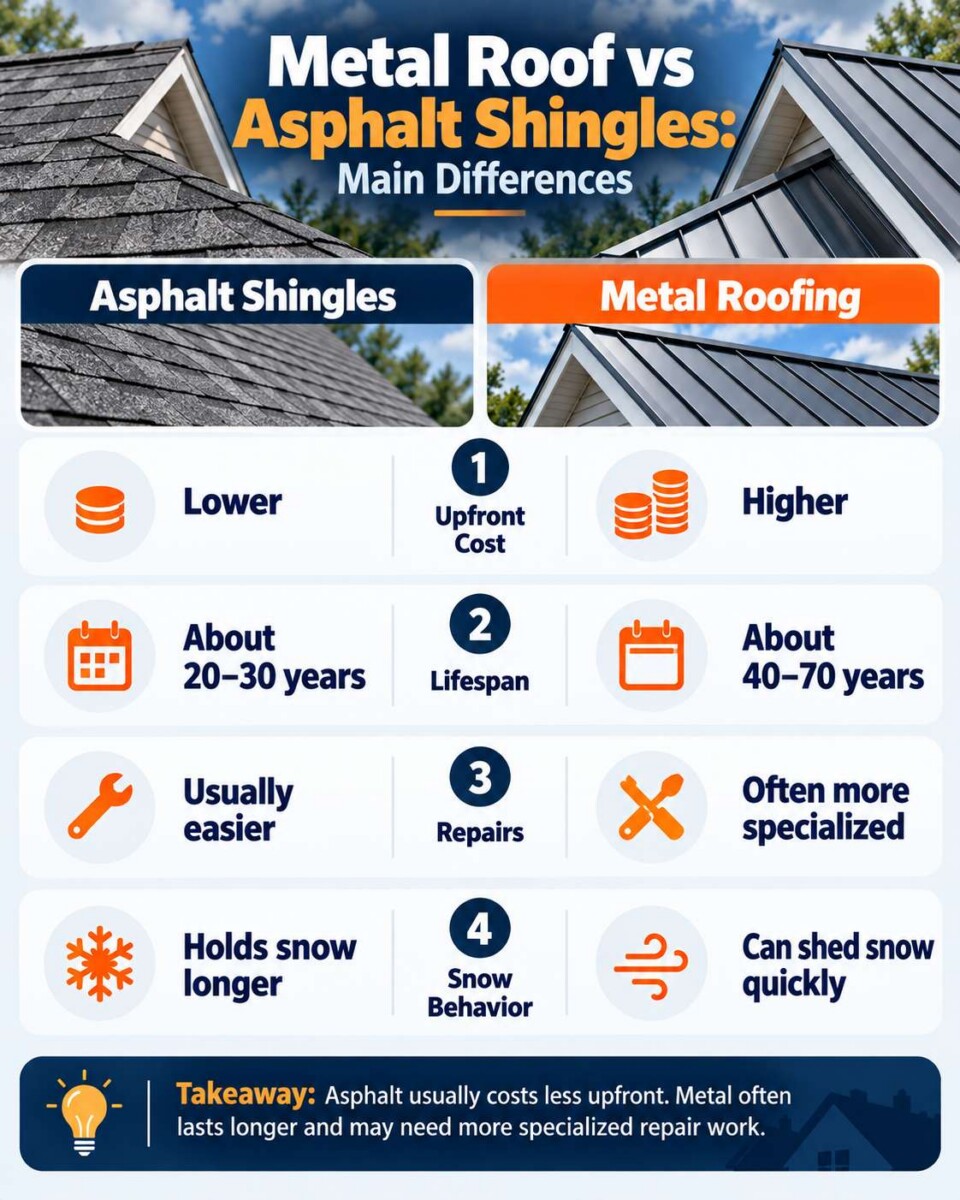
The biggest differences are upfront cost, expected lifespan, maintenance, repair access, and snow behavior. Product grade matters too, so compare specific roofing systems rather than broad material names.
What Is an Asphalt Shingle Roof?
An asphalt shingle is a fiberglass mat coated with asphalt and covered in ceramic granules. Shingles are nailed directly to the roof deck in overlapping rows. The two main types are:
- 3-tab shingles: basic, single-layer, and budget-friendly, with a shorter lifespan (about 20 years, InterNACHI).
- Architectural shingles: multi-layer, more durable (about 30 years, InterNACHI), and often made to look like wood or slate.
Asphalt is the most familiar roof in most neighborhoods. It comes in a very wide range of colors and styles. For a closer look at the two shingle grades, see our guide to 3-tab vs architectural shingles.
What Is a Metal Roof?
A metal roof is made from steel, aluminum, zinc, or copper. Panels attach to the roof deck with clips or fasteners over underlayment. Common styles include:
- Standing seam metal: long vertical panels with interlocking seams and concealed fasteners.
- Exposed-fastener panels: panels held by visible screws and washers that may need more attention over time.
- Corrugated metal: a wavy profile, common on farm and industrial buildings but also used on homes.
- Metal shingles: made to look like traditional shingles.
Metal roofing comes in many colors and finishes and can suit modern or traditional homes.
Metal vs Asphalt Comparison Table
| Factor | Metal Roofing | Asphalt Shingles |
|---|---|---|
| Upfront cost (Indiana, 2026 estimate) | $9 to $15 per sq ft installed | $4.50 to $7.50 per sq ft installed |
| Life expectancy (InterNACHI) | 40 to 80 years | 20 years (3-tab), 30 years (architectural) |
| Resale return (Cost vs. Value 2025, East North Central) | 45.9% of cost recouped | 69.2% of cost recouped |
| Snow behavior | Can shed snow quickly | Holds snow longer |
| Ice dam risk | Depends on attic heat loss, insulation, and ventilation | Depends on attic heat loss, insulation, and ventilation |
| Hail | Strong; some panels can dent cosmetically; FM 4473 is the impact test for metal panels | UL 2218 Class 4 shingles survive a 2-inch steel ball from 20 feet; basic shingles are not tested |
| Wind | Interlocking standing seam resists uplift | ASTM D7158 Class H shingles tested to 150 mph; Class F to 110 mph |
| Fire rating | Most systems are Class A | Can reach Class A, depending on underlayment and installation |
| Noise | Depends on decking, underlayment, and insulation below | Naturally quieter in rain |
| Repairs | Often more specialized | Usually easier |
| Maintenance | Depends on system (seams, fasteners, coatings) | Moderate (shingles, granule loss, moss) |
| Install time | Several days to a week | One to two days |
| Weight | Lightweight panels | Heavier layered surface |
| Recyclability | 100% recyclable | Often ends up in landfills |
| Local labor | More system-specific | Widely available |
How Much Does a Metal Roof Cost Compared to Asphalt Shingles?
Asphalt usually wins on initial price. Metal becomes more attractive when you expect to keep the home for decades. The figures below are Relentless Roofing Co. estimates for 2026, taken from our Indiana roof replacement cost guide for 2026 and Elkhart roof replacement cost guide.
| Cost Factor | Metal Roof | Asphalt Shingles |
|---|---|---|
| Installed cost per square foot (Indiana) | $9 to $15 | $4.50 to $7.50 |
| 2,000 sq ft roof (Elkhart) | $16,000 to $28,000 | $10,500 to $17,500 |
| Standing seam project (Indiana) | Usually starts around $19,000, can pass $30,000 | n/a |
| Life expectancy (InterNACHI) | 40 to 80 years | 20 to 30 years |
| Replacements during a 30-year stay | Likely none | Likely at least one more |
| Maintenance | Low to moderate, depends on system | Moderate |
| Future repairs | May need a metal specialist | Easier in many cases |
For context, Angi’s national average for a full roof replacement is $9,609, or $4 to $11 per square foot (Angi, March 2026). If you are leaning toward a premium metal system, our standing seam metal roof cost guide for Indiana breaks down that option, and our metal roofing cost guide covers other metal types.
What Cost Over Time Really Looks Like
The long-term gap comes from replacement cycles. InterNACHI puts architectural asphalt shingles at about 30 years and metal at 40 to 80 years, and a Metal Construction Association study of aluminum-zinc coated steel standing seam roofs found service lives of more than 60 years (MCA and ZAC Association, 2014). A homeowner who stays 30 years on an asphalt roof installed a few years before they bought will likely pay for at least one more full tear-off and replacement. A metal roof may cover the entire ownership period.
Here is a labeled 30-year scenario for a 2,000 sq ft Elkhart roof, using the estimate ranges above. It assumes an architectural asphalt roof reaches 25 years before replacement, and ignores inflation, repairs, and energy costs.
| 30-year scenario (hypothetical, 2,000 sq ft Elkhart roof) | Asphalt shingles | Standing seam metal |
|---|---|---|
| Roofs purchased in 30 years | 2 | 1 |
| Cost per roof (2026 estimate) | $10,500 to $17,500 | $16,000 to $28,000 |
| 30-year roofing spend | $21,000 to $35,000 | $16,000 to $28,000 |
| Roof life remaining at year 30 | About 20 years on the second roof | 10 to 50 years |
That is why ownership timeline matters more than sticker price:
| Your Situation | Asphalt | Metal |
|---|---|---|
| Lower starting budget | Strong fit | Harder to justify |
| Staying 5 to 10 years | Often practical; higher resale recoup | Payback may be limited |
| Staying 20 to 30+ years | May require another replacement | Longer lifespan becomes more valuable |
| Simple future repairs | Easier in many cases | May need a metal specialist |
A homeowner planning to sell in eight years may value the lower upfront cost. Someone expecting to stay 30 years may care more about avoiding another full roof replacement.
Free roof inspection: Not sure which system your home can support? Call Relentless Roofing Co. at 574-218-0642 to schedule a free roof inspection.
How Long Do Metal Roofs Last Compared to Asphalt Shingles?
InterNACHI’s standard life expectancy chart puts architectural asphalt shingles at about 30 years, basic 3-tab shingles at about 20 years, and metal roofing at 40 to 80 years. By metal type, steel roofs are often placed around 40 to 50 years, while aluminum and copper can reach 60 to 70 years (Relentless, from manufacturer ranges). The MCA study above found that unpainted 55% aluminum-zinc coated steel standing seam roofs last more than 60 years across five U.S. climate regions, provided fasteners and sealants get periodic maintenance.
Actual life depends on product quality, installation, maintenance, weather exposure, ventilation, and roof design. For a wider look at every roof type, read how long roofs last in Indiana.
Why Are Northern Indiana Homeowners Comparing Metal and Asphalt?
Northern Indiana brings snow, freezing temperatures, spring thaws, wind, hail, and fast temperature swings. Elkhart and St. Joseph County roofs are designed for a 30 pounds per square foot ground snow load and a 115 mph ultimate design wind speed, and Indiana code requires an ice barrier at the eaves here (2020 Indiana Residential Code, Table R301.2(1) and R905.1.2). These conditions expose weak flashing, old shingles, loose fasteners, poor underlayment, and attic problems.
According to our Michiana Roof Report 2026, metal roofing was referenced in 12% of detailed homeowner messages. That figure shows homeowner interest during the study period. It does not prove year-over-year growth. The same study found winter or ice damage in 12% of relevant homeowner messages.
That second number matters because winter leaks are often blamed on the roof covering alone. An ice dam forms when heat warms part of a snow-covered roof. Meltwater runs down to the colder eaves and freezes again. Roofing material affects how snow moves, but attic air leaks, insulation, ventilation, roof shape, and drainage usually control why the problem starts.
Which Roof Performs Better in Snow, Ice, Wind, and Hail?
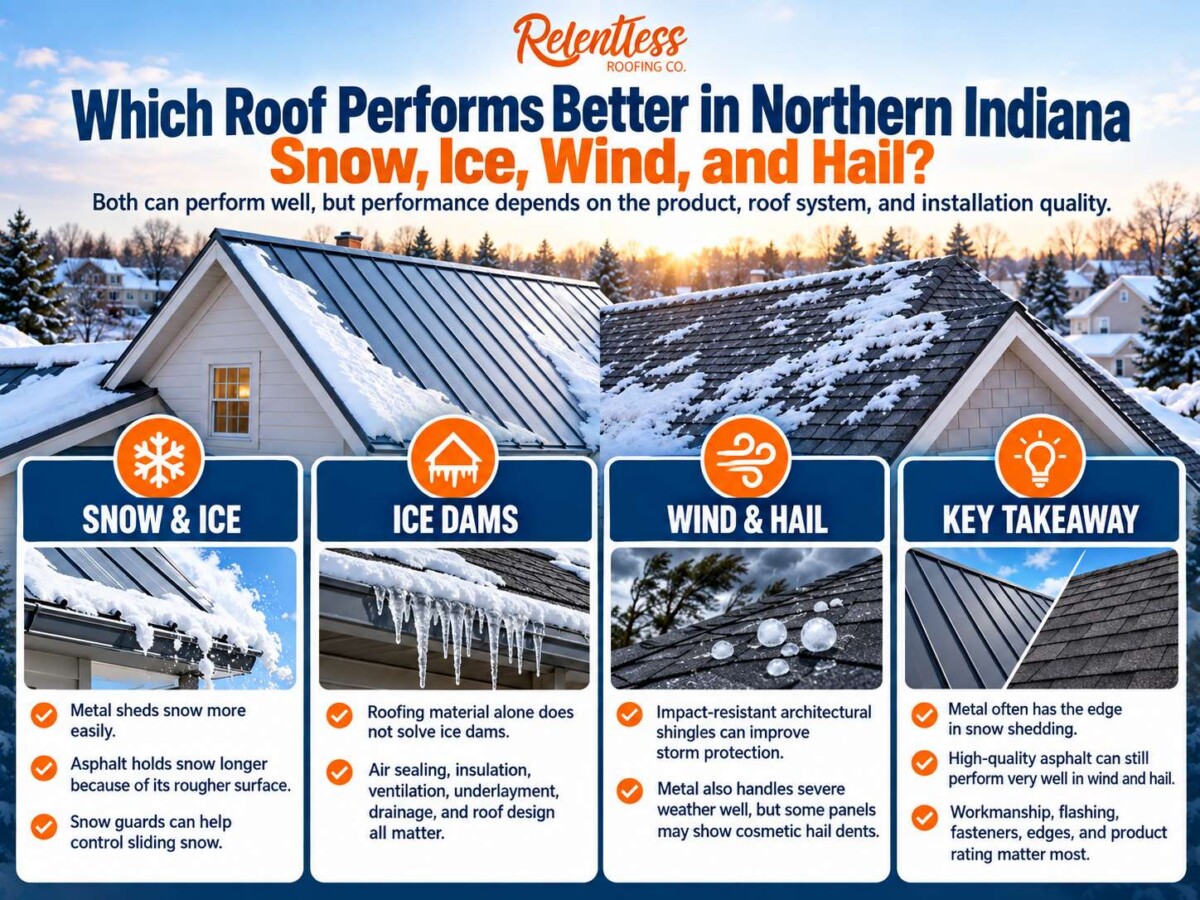
Both materials can perform well in Northern Indiana when the right product is installed correctly. Metal usually has the edge in snow shedding. High-quality asphalt can still provide strong wind and hail performance.
Snow and Snow Guards
Smooth metal panels let snow slide off more easily, which reduces long-term snow load on the roof deck. Asphalt has more surface texture, so snow stays in place longer. Snow is heavy: by IBHS equivalents, 3 to 5 inches of packed snow or 10 to 12 inches of fresh snow weigh about 5 pounds per square foot, so a roof holding 2 feet of packed snow is near the 30 psf Elkhart County design load.
Sliding snow can be a hazard above doors, sidewalks, decks, and driveways. Snow guards slow or control that movement, especially on steeper slopes. Their placement should match the roof design and expected snow load.
Ice Dams
A metal roof cannot fix a warm, leaky attic. Air sealing, insulation, ventilation, underlayment, drainage, and roof geometry all affect ice dam risk on either material. ENERGY STAR recommends R-60 of attic insulation for an uninsulated attic in Climate Zone 5, which includes Elkhart County, and the code requires the ice barrier at the eaves no matter which covering you choose.
If your home has recurring winter leaks, have these areas checked before assuming a material change will solve the problem. Fixing the source may matter more than switching from shingles to metal.
Wind
Standing seam panels lock together, which helps resist uplift in high winds. Asphalt shingles can lift, curl, or tear off in strong winds, especially when they are aging or were not installed correctly. Architectural shingles are commonly rated ASTM D7158 Class H (tested to 150 mph) and ASTM D3161 Class F (110 mph) (GAF, 2024), and manufacturer wind warranties, such as the 130 mph limited wind warranty on Owens Corning TruDefinition Duration STORM shingles, depend on using the full accessory system. Roof edges, flashing, and the fastening system matter as much as the material.
Hail
Metal handles severe weather well, though hail can leave cosmetic dents on some panels. Softer metals such as aluminum dent more easily, while thicker steel and standing seam systems resist impact better. FM 4473 is the impact test used for metal roofing panels.
Basic shingles can crack or lose granules after repeated hits; the National Weather Service calls hail of 1 inch or larger severe, and hail that size bruises standard shingles. UL 2218 Class 4 impact-resistant architectural shingles are tested with a 2-inch steel ball dropped from 20 feet and provide much stronger protection (GAF, 2024). After a storm, watch for the signs you need roof repair after a storm, and see our hail damage roof repair service if you find damage.
Fire
Most metal roofing systems carry a Class A fire rating, the highest available, because metal does not burn. Asphalt shingles can also reach Class A, depending on the underlayment and installation quality.
Is a Metal Roof Noisier Than Asphalt Shingles?
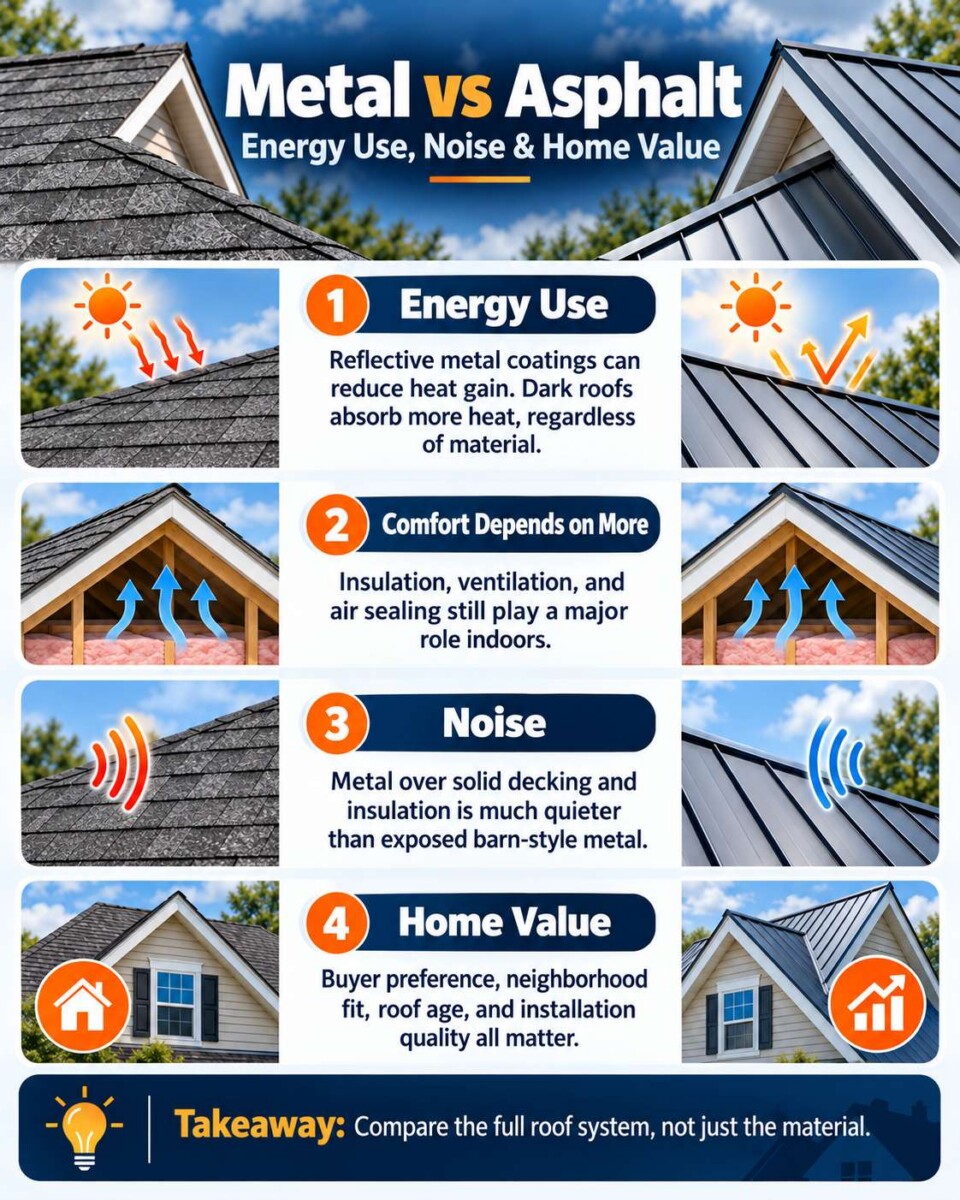
Not when it is installed as a full residential system. Metal can amplify the sound of heavy rain or hail, but noise depends heavily on the layers below the roof.
Metal installed over solid decking, underlayment, insulation, and an attic performs very differently from exposed metal on a barn. Thicker metal also dampens sound better. Asphalt shingles are naturally quieter because their thick layers buffer rain and light wind. Judge the complete roof assembly, not the panel alone.
Energy Use: Does a Metal Roof Lower Bills in Indiana?
Metal can reflect more solar heat when it has a suitable coating or a lighter finish. The U.S. Department of Energy notes that a reflective “cool” roof surface can stay more than 50°F cooler than a conventional dark roof in the same conditions. Dark roofing absorbs more heat no matter the material. Energy savings of 10 to 25% are cited for metal in warm regions, but DOE also warns that cool roofs carry a winter heating penalty and can raise total energy costs in colder climates if the heating penalty exceeds the cooling savings (DOE Energy Saver, “Cool Roofs”). In Northern Indiana, expect smaller savings than a southern homeowner would see.
Attic insulation, ventilation, and air sealing still play a major role in comfort and bills. For a full breakdown, read which is more energy efficient: metal or shingles.
Does a Metal Roof Increase Home Value?
Home value is less predictable than many sales pitches suggest, and the best available data favors asphalt at resale. The Remodeling 2025 Cost vs. Value Report found that in the East North Central region, which includes Indiana, an asphalt shingle roof replacement (job cost $29,253) returned $20,252 at resale, or 69.2% of its cost, while a metal roof replacement (job cost $47,473) returned $21,812, or 45.9%. In dollar terms the two roofs added almost the same resale value; the metal roof simply cost much more.
A long-lasting metal roof can still appeal to buyers who want low maintenance and weather resistance. Architectural shingles may fit traditional neighborhoods or HOA rules more easily, and homes with asphalt roofs can attract budget-minded buyers.
Roof age, condition, installation quality, and remaining useful life often matter as much as the material. If you are selling within 5 to 10 years, the higher upfront cost of metal will not fully come back to you.
Insurance: Will a Metal Roof Lower Your Premium?
It might, but do not count on it. Some insurers offer discounts for impact-resistant roofs, and a Class A fire rating can help with underwriting. Rules vary by company and policy, and some insurers worry about the cost of repairing dented panels. Wind and hail are the most common homeowners claims nationally, at 2.80 claims per 100 house-years with an average claim of $14,747 from 2019 to 2023 (Insurance Information Institute, ISO data), which is why insurers care about impact ratings.
Ask your insurer about the exact roofing product before counting on any premium reduction. After a new roof goes on, read our guide on whether to tell your insurance company about your new roof.
Matching is another point to know. If an older shingle line or panel profile is discontinued, a repair may not match the rest of the roof. Indiana has no law that requires an insurer to pay for matching materials, so review your policy wording before a claim.
Installation, Maintenance, and Repairs
Asphalt is simpler to install and repair because more residential crews work with shingles. A typical asphalt roof goes on in one to two days. Metal installation needs careful panel alignment and room for expansion and contraction, often takes several days to a week, and should be done by a crew that knows the exact panel system.
Asphalt ownership usually involves:
- Checking for missing or damaged shingles after storms
- Watching for granule loss as the roof ages
- Cleaning gutters and checking for moss or algae in shaded areas
- Replacing small damaged areas when practical (replacing 10 to 20 shingles runs about $200 to $600 in Elkhart, Relentless estimate, 2026)
- Finding matching shingles if an older product line has changed
Metal ownership usually involves:
- Checking seams, flashing, and sealants
- Inspecting exposed fasteners on systems that use them
- Clearing leaves and branches that block drainage
- Watching coating condition and treating any rust
- Finding matching panels when repairs are needed (minor metal repairs run about $500 to $1,000 in Elkhart, Relentless estimate, 2026)
If you are thinking about putting metal over your current shingles, read can you install a metal roof over shingles first. The existing roof should always be inspected before it is covered, and the residential code allows no more than two layers on a roof (IRC R908.3).
Warranties: Material vs Workmanship
Always separate the material warranty from the workmanship warranty. One covers qualifying product defects. The other covers qualifying installation problems.
| Warranty | Metal Roofing | Asphalt Shingles |
|---|---|---|
| Typical material warranty (industry ranges, Relentless 2025 summary) | 40 to 50 years | 10 to 30 years, depending on grade |
| Top-tier options | Some 50-year non-prorated warranties | “Lifetime” warranties (usually 50 years), prorated |
| Verified example | n/a | Owens Corning TruDefinition Duration STORM: limited lifetime, 130 mph limited wind warranty, 10-year algae resistance, UL 2218 Class 4 |
| Labor coverage | Often limited to about 10 years | Proper installation and maintenance usually required |
Ask your contractor for both documents in writing and read what each one excludes.
Environmental Impact
Metal roofing is 100% recyclable and is often made from recycled metal. Its production uses more energy, but one metal roof can outlast two asphalt roofs. Asphalt shingles are petroleum-based, their recycling rate stays low, and old shingles often end up in landfills. More replacement cycles mean more waste.
Which Is Better for Your Home: Metal or Asphalt?
Asphalt often makes sense if you want a lower starting cost, easy repair access, a traditional look, and a higher share of the cost back at resale. Metal becomes more attractive if you are a long-term owner who can handle the higher price and wants a longer service life. Your roof shape and attic condition can change either decision.
| Your Priority | Option to Compare First |
|---|---|
| Lower upfront cost | Architectural asphalt |
| Selling within 10 years | Architectural asphalt (69.2% recouped vs 45.9%, Cost vs. Value 2025 ENC) |
| Staying 25+ years | Standing seam metal |
| Easy future repairs | Asphalt |
| Frequent hail concerns | UL 2218 Class 4 asphalt or thicker steel standing seam |
| Snow shedding | Metal |
| Planning to add solar panels | Metal |
| HOA or traditional appearance | Architectural asphalt |
| Recurring ice dams | Inspect the attic and roof assembly before choosing either |
Questions to Ask Before You Choose
- How long do I expect to own this home? A longer stay makes metal’s longer service life more valuable.
- Which exact product am I being quoted? Confirm whether it is architectural shingles, impact-resistant shingles, standing seam metal, exposed-fastener panels, or another system, and ask for its UL 2218, ASTM D7158, or FM 4473 rating.
- Are my roof deck and attic in good shape? Moisture, poor ventilation, or insulation problems should be fixed during replacement.
- Has my home had ice dams or winter leaks? Past winter problems can point to attic issues and may change your repair vs replacement decision.
- What maintenance will this system need? Ask which parts need regular checks and which wear first.
- What do the warranties cover? Review material and workmanship coverage separately.
How Relentless Roofing Co. Helps You Decide
We install both asphalt shingle roofs and metal roofs, so our job is to match the system to your home, not to push one material. A roof inspection shows whether your deck, attic, and flashing are ready for either option and which product fits your budget and timeline.
Explore our roof replacement and metal roof replacement services. We work across Michiana, including Elkhart, Goshen, South Bend, Mishawaka, and Granger.
FAQs
Is a metal roof better than asphalt shingles in Northern Indiana?
It depends on your timeline. Metal is better for long service life (40 to 80 years, InterNACHI), snow shedding, and avoiding another full replacement. Asphalt shingles cost less upfront, are easier to repair, recoup more at resale (69.2% vs 45.9%, Cost vs. Value 2025 East North Central), and work well if you plan to sell within 5 to 10 years.
How much more expensive is a metal roof than asphalt shingles?
A metal roof often costs 1.5 to 2 times more than asphalt shingles at installation. In Indiana that is about $9 to $15 per square foot for metal versus $4.50 to $7.50 for asphalt, or $16,000 to $28,000 versus $10,500 to $17,500 for a 2,000 sq ft Elkhart roof (Relentless Roofing Co. estimates, 2026). Its longer lifespan can balance that cost if you stay in the home for decades.
Can you install a metal roof over existing asphalt shingles?
Sometimes. Some metal systems can go over existing shingles if local rules, manufacturer instructions, structural conditions, and the roof deck allow it, and the code allows no more than two layers in total. The existing roof should be inspected first, because covering wet decking, damaged flashing, or hidden rot leaves the original problem in place.
Do metal roofs need snow guards in Northern Indiana?
Some roofs do. Smooth metal can release snow quickly, especially on steeper slopes. Snow guards may be useful above doors, walkways, decks, and driveways where sliding snow could create a hazard. Their placement should match the roof design and the 30 psf design snow load used in Elkhart County.
Do metal roofs lower insurance costs in Indiana?
They might. Some insurers offer discounts for impact-resistant roofs, and fire resistance can help with underwriting. Rules vary by company and policy, so ask your insurer about the exact roofing product and its UL 2218 or FM 4473 rating before counting on any premium reduction.
What are the biggest disadvantages of a metal roof?
The main concerns are higher upfront cost, a lower share of cost recouped at resale (45.9% in our region per Cost vs. Value 2025), specialist installation, more involved repairs, and possible cosmetic denting from hail. Exposed-fastener systems may also need fastener checks as they age, so ask which metal system is being quoted.
Get a Straight Answer for Your Roof
Metal vs asphalt has no single answer for every Northern Indiana home. Compare your budget, ownership timeline, roof design, attic condition, and weather exposure before choosing. Call Relentless Roofing Co. at 574-218-0642 to schedule a free roof inspection, and we will help you compare the right systems for your home.
You may also want to read: When is the best time to replace a roof in Indiana? What local data shows